Archive
When Should You 4-Bet in Poker? The Ultimate Guide to 4-Bet Strategy
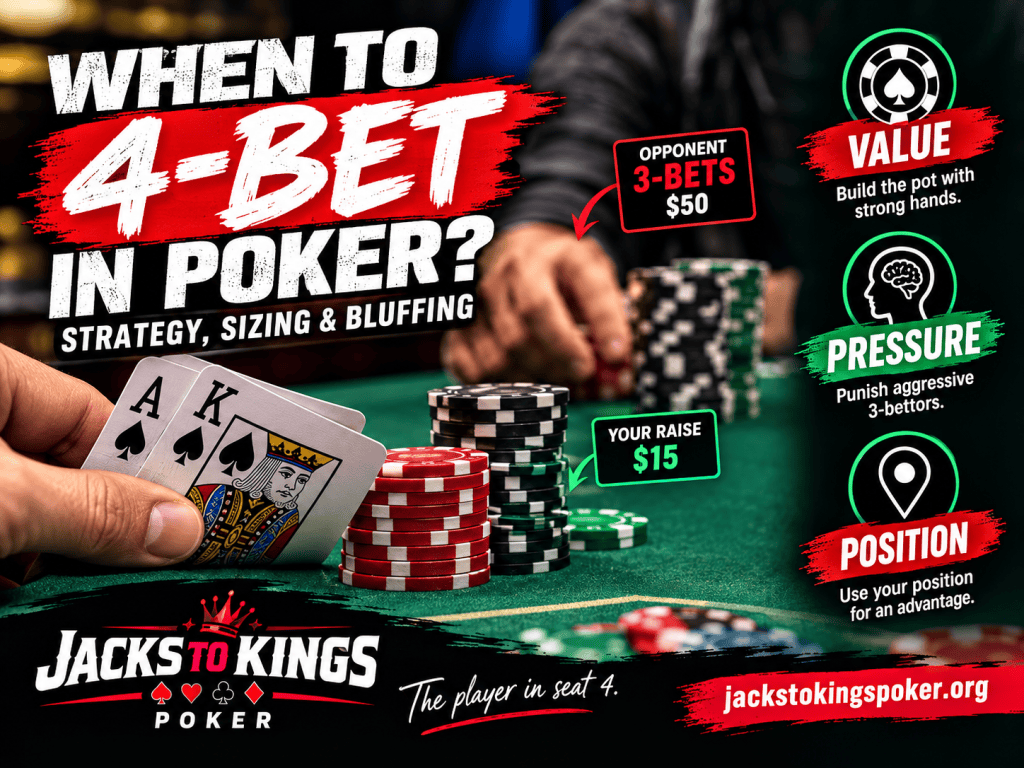
In No-Limit Texas Hold’em, a 4-bet is one of the most powerful weapons in your preflop arsenal. It can build a monster pot with a premium hand, punish an aggressive 3-bettor, or force an opponent to fold before the flop. But timing matters. A poorly chosen 4-bet can turn a manageable pot into an expensive mistake. The secret isn’t simply having a big hand—it’s understanding your opponent, your position, your stack sizes, and how their range reacts to pressure.
When to 4-Bet for Value
The most straightforward reason to 4-bet is when you hold a premium hand such as pocket Aces, pocket Kings, or Ace-King suited. Pocket Queens and other strong hands can also be candidates depending on the opponent and situation. For example, you’re playing $2/$5 No-Limit Hold’em with $500 effective stacks. You raise to $15 with A♠K♠, an opponent 3-bets to $50, and you 4-bet to $120. You’re building a pot with a strong hand while making weaker holdings pay to continue. Before you raise, though, have a plan: if your opponent shoves, will you call? With Ace-King suited against many aggressive players, continuing may be reasonable, but the right decision depends on their range and the money already invested. A 4-bet should have a purpose—not be an automatic reaction to a 3-bet.
When to 4-Bet Bluff
A 4-bet doesn’t always have to represent pocket Aces. Against opponents who 3-bet too frequently and can fold to further aggression, a well-timed bluff can be profitable. A hand such as A-5 suited is sometimes a good candidate because holding an Ace reduces the combinations of pocket Aces and Ace-King your opponent can have. It also retains some potential to make a strong hand if called. Position matters, too. A late-position open that gets 3-bet by an aggressive blind defender can create a better bluffing opportunity than an early-position raise facing a tight player’s 3-bet. However, don’t confuse aggression with strategy. Against a calling station who refuses to fold, bluffing is usually a poor investment. Save the fancy moves for players who are capable of letting go of a hand.
When NOT to 4-Bet
One of the biggest mistakes in low-stakes cash games is 4-betting without considering what happens next. If a tight opponent 3-bets your early-position raise, their range may be strong enough that marginal hands and bluffs become unattractive. Likewise, hands that look pretty but struggle against a shove can create difficult, expensive decisions. Stack depth matters: with shallow stacks, a 4-bet can effectively commit you to the pot; with deeper stacks, you may have more room to maneuver after the flop. Your 4-bet sizing should also reflect the situation. As a general starting point, a 4-bet in position might be around 2.2–2.5 times the 3-bet size, while out of position you may use a larger size, often around 2.5–3 times. These are guidelines, not rules—adjust for the original raise, stack sizes, and opponent tendencies.
The Bottom Line: Make Your 4-Bets Count
The best 4-bettors aren’t necessarily the most aggressive players at the table. They’re the players who understand why they’re raising and what they’re trying to accomplish. Sometimes the goal is to get value from a weaker hand. Sometimes it’s to make an aggressive opponent pay for 3-betting too wide. And sometimes folding is simply the most profitable decision. Pay attention to who is 3-betting, which positions are involved, and how often your opponent folds to pressure. Build a plan before putting those extra chips in the pot. Master those fundamentals, and your 4-bets can become a calculated part of your strategy instead of an expensive guessing game.
Play smart. Apply pressure. Know when to pull the trigger
Visit jackstokingspoker.org for more poker strategy, real-hand stories, and practical tips to improve your results.
If you enjoyed this article please like, share, comment, and subscribe. Please click on our sponsor links to keep these articles free! Thanks for reading and I’ll see you at the tables!

Mississippi Stud Poker: How to Play and the Best Strategy
In my recent casino visits I came across a game of poker, I had not played before and had only other seen one other time. So I had to play it, dropped a few bucks and enjoyed it which led me to this article. If you enjoy poker but want to try something different from a traditional poker table, Mississippi Stud is worth a look. It’s a poker-based casino table game where you are not playing against the dealer or other players. Instead, your final five-card poker hand determines whether you win, lose, or push. The real challenge is deciding how much to bet—or whether to fold—as additional cards are revealed. You begin with an Ante, receive two hole cards, and three community cards are revealed one at a time. At each of the three betting stages, you can fold or raise 1x, 2x, or 3x your Ante. (Wizard of Odds)
The game starts with your two cards and the first decision. You should generally raise 3x with any pair, while hands containing strong high cards are often worth a smaller 1x raise. A particularly useful starting hand is 6-5 suited, which has enough straight and flush potential to continue. Weak combinations—especially hands containing only low cards with little potential—should usually be folded. Once the first community card appears, the strategy becomes more interesting. Made hands such as a pair of 6s or better can justify a 3x raise, while strong straight or flush draws can also warrant aggressive betting. (Wizard of Odds)
Mississippi Stud Strategy Cheat Sheet:
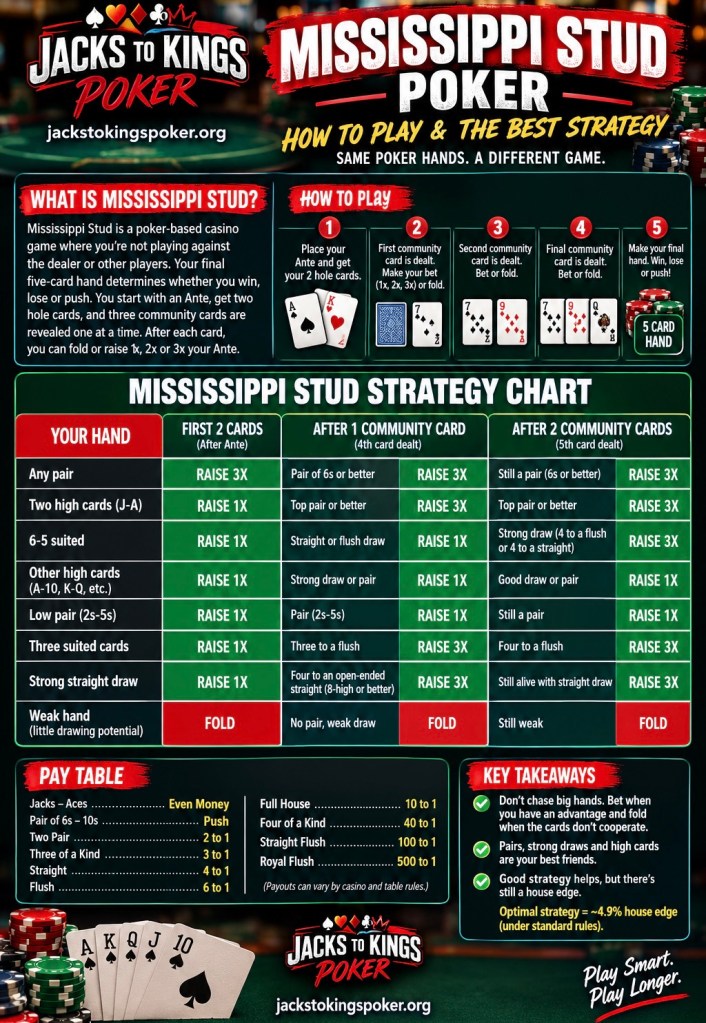
The standard pay table makes the game especially interesting because Jacks through Aces pay even money, while a pair of 6s through 10s is normally a push. Two pair pays 2-to-1, three of a kind 3-to-1, a straight 4-to-1, a flush 6-to-1, a full house 10-to-1, four of a kind 40-to-1, a straight flush 100-to-1, and a royal flush can pay 500-to-1. (Wizard of Odds) The key Mississippi Stud lesson is that you don’t want to blindly chase big hands. Good strategy is about maximizing your bets when you have an advantage and getting out when the cards don’t cooperate. And remember: this is still a casino game with a house edge—even optimal strategy doesn’t turn it into a guaranteed winner. The published optimal strategy produces a house edge of roughly 4.9% under the standard rules and pay table. (Wizard of Odds)
If you enjoyed this article please like, share, comment, subscribe. Please click on our sponsor Ads to keep these articles free. Thanks for reading and I’ll see you at the tables!
When Should You C-Bet in Poker? When to Fire and When to Check
The continuation bet (C-bet) is one of the most common weapons in poker, but that doesn’t mean you should fire every flop just because you raised preflop. C-betting makes sense when the flop favors your perceived range, especially on dry boards where your opponent is unlikely to have connected. A flop like K♣ 7♦ 2♠ is a great example. As the preflop raiser, you can represent plenty of strong kings, overpairs and big hands. A small bet can often get the job done without risking a huge portion of your stack.
Knowing when NOT to C-bet is just as important. Connected, coordinated boards such as 9♠ 8♠ 7♥ can hit your opponent’s calling range hard. If you’re holding A♣ K♦ and completely miss, blindly firing can put you in a tough spot when you get called or raised. Multiway pots are another reason to slow down—your bluff has to get through multiple opponents. Sometimes the best poker play is simply checking and seeing what develops.
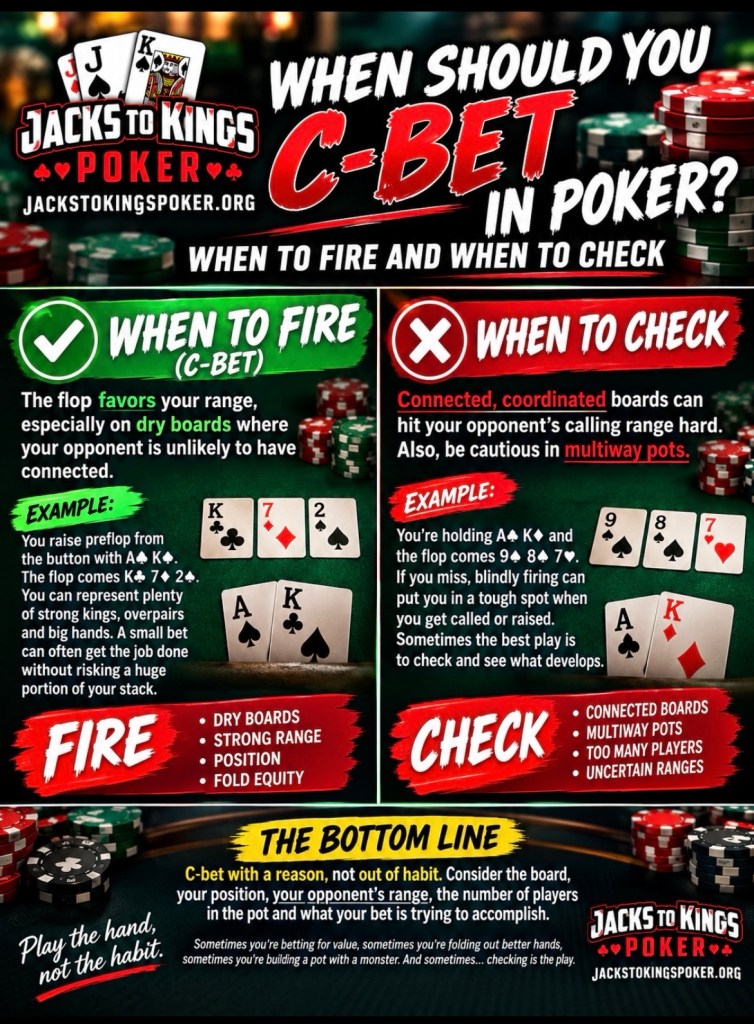
The key is to C-bet with a reason, not out of habit. Consider the board, your position, your opponent’s range, the number of players in the pot and what your bet is trying to accomplish. Sometimes you’re betting for value, sometimes you’re folding out better hands, and sometimes you’re building a pot with a monster. And sometimes… checking is the play. Jacks to Kings Poker — play the hand, not the habit.
If you enjoyed this article please, like, share, comment and subscribe! Thanks for reading and I’ll see you at the tables!
The Power of the Odd Bet: Why $27 Can Be Better Than $25
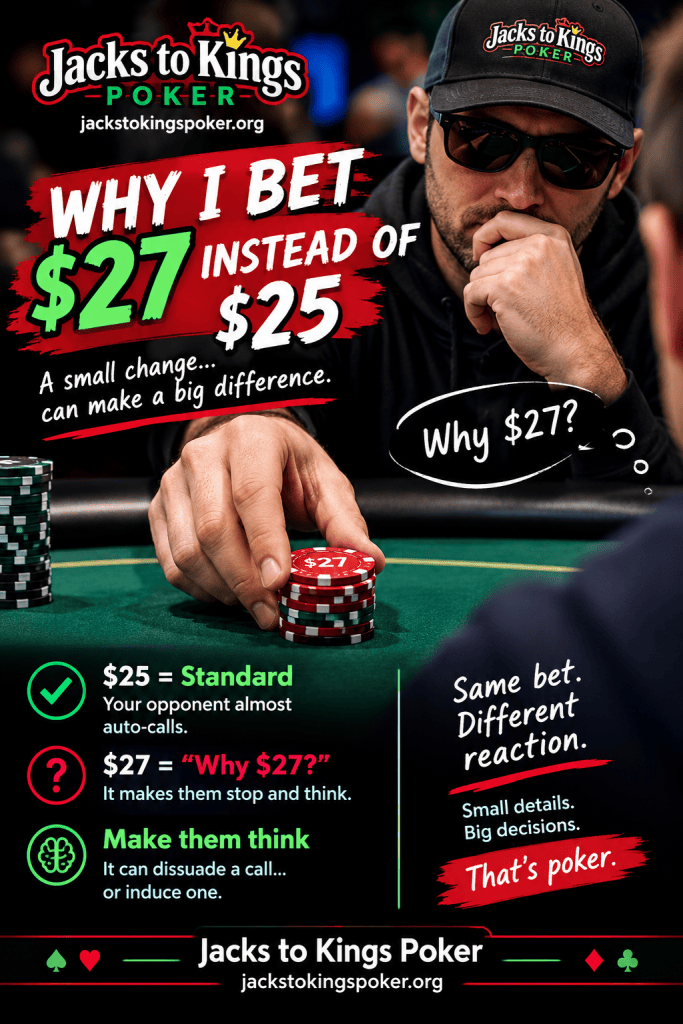
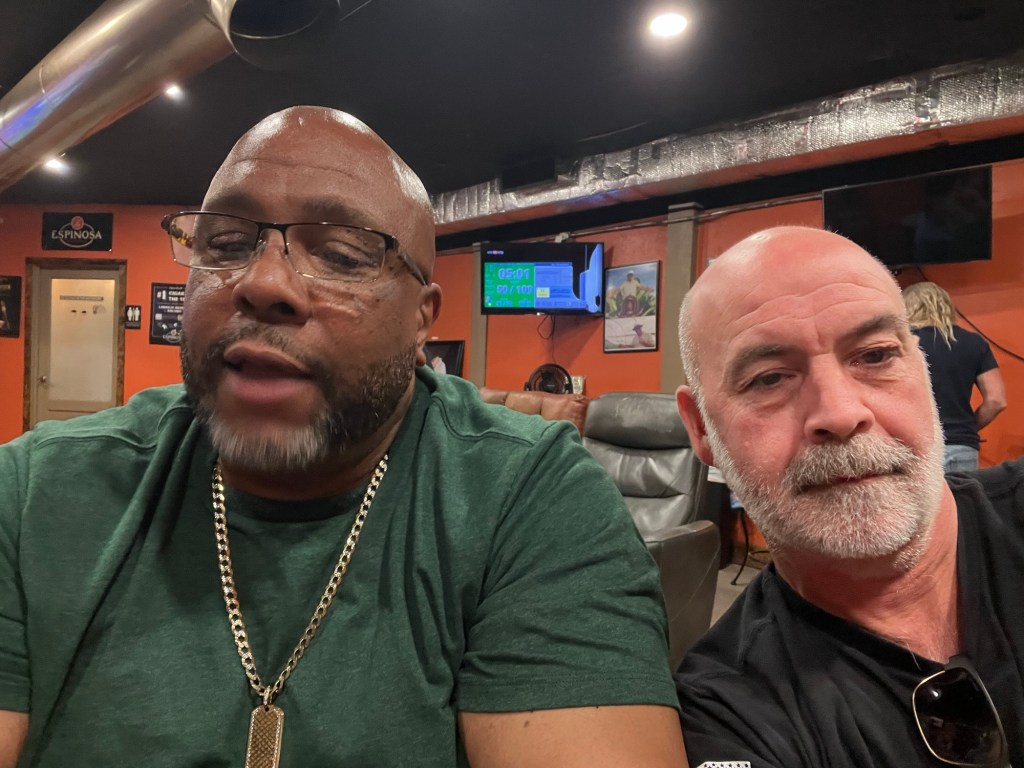
Tonight I was talking to a friend of mine, I call him Lem, As usual we were talking poker strategy and we got into a strategy we both enjoy to mix things up a bit that when used correctly mixes up the game and can even throw good players off balance.
Sometimes two extra dollars can make a bigger difference than you think.
In live poker, players get comfortable with familiar bet sizes. $15, $20, $25, $30, $50 — these numbers become almost automatic. That is exactly why occasionally using an odd-dollar amount can throw an opponent off.
Instead of betting $25, try $27.
Instead of $50, maybe $53.
It isn’t about trying to look clever or turning every bet into a math problem. It’s about breaking your opponent’s rhythm and making them stop for a second to think about what your bet actually means.
Why Does $27 Feel Different Than $25?
Imagine you’re playing $1/$3 No-Limit Hold’em.
You bet $27 on the flop.
Your opponent was probably expecting something like $20, $25, or $30. Now they’re looking at $27 and have to process it.
“Why $27?”
That tiny question can be valuable.
Maybe they interpret it as a very specific value bet. Maybe they think you’re trying to discourage a call. Maybe they believe you’re uncomfortable and are trying to buy the pot cheaply.
The important part is that you’ve created uncertainty.
And uncertainty can lead to mistakes.
Odd Sizing Can Dissuade a Call
Suppose you’ve got a strong but vulnerable hand.
The pot is $62 and you bet $27.
A player holding a marginal hand might have been willing to call $25 without thinking much about it. But $27 makes them reconsider.
It’s only $2 more, but psychologically it can feel like a more deliberate decision.
They may think:
“What does he have? Why $27? Is he trying to set the price of the hand?”
Sometimes that extra hesitation is enough to turn a marginal call into a fold.
That’s especially useful against players who don’t like making difficult decisions.
But It Can Also Induce a Call
Here’s the fun part.
Odd sizing doesn’t always discourage a call. Sometimes it can encourage one.
Imagine you bet $27 with a hand you’re willing to get value from, and your opponent thinks:
“That’s a weird number. He’s probably just trying to look strong.”
They may convince themselves that you’re making an unusual bet because you’re bluffing.
Now you’ve accomplished the opposite of what they expected.
They’re calling.
This is where understanding your opponent matters.
Against a player who tends to overthink unusual bets, $27 might induce curiosity. Against a straightforward player who doesn’t want to deal with weird sizing, it might discourage a marginal call.
Same bet. Different opponent. Different reaction.
The Real Trick Is Knowing When to Use It
You don’t want to start betting $23, $27, $31 and $46 on every street.
Then the odd sizing becomes your normal sizing — and you’ve accomplished nothing.
Instead, use it selectively.
Maybe you’ve been betting $25 all night and suddenly fire $27 when you have a big hand.
Or perhaps you’ve been making standard $20 continuation bets and suddenly bet $23 when you’re bluffing.
Now your opponent has something new to think about.
That’s where odd sizing can become part of your table image.
Don’t Confuse Weird With Random
There’s an important distinction.
Odd sizing should have a purpose.
If you’re betting $27 simply because you think $27 looks cool, you’re not necessarily gaining anything.
But if you’re thinking:
● “I want to make this marginal hand uncomfortable.”
● “I want my opponent to wonder why I chose this size.”
● “I want to make calling slightly less automatic.”
● “I think this opponent will interpret an unusual size as weakness.”
● “I want to get a little more value without making the bet look significantly larger.”
Then the sizing has a reason behind it.
And that’s poker.
The Psychological Edge
Poker isn’t just about cards and pot odds.
It’s also about decision-making under uncertainty.
Players become comfortable when everything looks familiar. Standard bet sizes make decisions easier because opponents immediately understand what they’re facing.
An unusual amount interrupts that process.
$25 feels like a bet.
$27 can feel like a message.
Your opponent may not even consciously realize that the number is affecting them. But if it causes them to take an extra few seconds, reconsider a marginal hand, or assign a different range to you, you’ve already accomplished something.
And remember: you’re only risking an extra $2 compared with the $25 bet.
That’s a pretty inexpensive way to make your opponent think.
The Seat 4 Lesson
At the poker table, we’re always looking for little edges.
Sometimes the edge isn’t a huge bluff or a perfectly timed check-raise.
Sometimes it’s simply betting $27 instead of $25.
The goal isn’t to confuse your opponent just for the sake of confusing them. The goal is to make their decisions a little harder while keeping your own decisions intentional.
So the next time you’re reaching for those chips, ask yourself:
Does this really need to be $25?
Maybe $27 tells the better story.
If you enjoyed this article please like,share,comment, and subscribe! Please click on our sponsor links to keep these articles free!
Thank you for reading and I will see you at the tables!

The Value of the Check-Call in $1/$3 No-Limit Hold’em
Sometimes the best poker play is the one that looks like you’re doing nothing.

At a $1/$3 No-Limit Hold’em table, there’s a constant temptation to bet, raise, and apply pressure. Aggression is important, but another weapon every poker player should have in their toolbox is the check-call.
A check-call allows you to keep weaker hands and bluffs in your opponent’s range while controlling the size of the pot. Instead of building a massive pot with a marginal hand, you let your opponent do some of the betting for you.
Why Check-Calling Works
Imagine you’re in the big blind with A♠9♠ and defend against a button raise. The flop comes A♦7♣4♥.
You have top pair, but it’s not necessarily a hand that wants to play for stacks. If you lead into your opponent, you may fold out hands you beat while getting action primarily from better aces and strong draws.
Checking gives your opponent an opportunity to bluff or bet worse hands.
When they fire, you can call and keep those weaker hands in the pot.
That’s the hidden value of the check-call.
Don’t Confuse Checking With Being Weak
One of the biggest mistakes recreational players make is assuming that checking means weakness.
It doesn’t.
A well-timed check can be a trap, a pot-control play, or a way to induce aggression.
At $1/$3, you’ll encounter plenty of players who automatically stab when checked to. Against those opponents, checking a medium-strength hand can be much more profitable than betting yourself.
You’re essentially saying:
“Go ahead. Tell me how much you want to put into this pot.”
The Key Is Knowing Your Opponent
The check-call becomes especially powerful when you understand your opponent’s tendencies.
Against an aggressive player who frequently continuation-bets, checking can allow them to put money into the pot with hands that would have folded to your bet.
Against a passive player who rarely bluffs, however, a check-call deserves more caution. Their bet may represent genuine strength.
Poker isn’t about making the same play every time. It’s about understanding why the play works against the particular player sitting across from you.
Check-Call Doesn’t Mean Check-Call Forever
Another important point: calling the flop doesn’t mean you have to call every street.
If the turn dramatically changes the board or your opponent suddenly increases their bet sizing, reassess the situation.
The beauty of the check-call is that it gives you information without committing your entire stack.
You can call the flop, evaluate the turn, and make a better decision with more information.
The Bottom Line
At $1/$3 No-Limit Hold’em, you don’t have to win every pot by being the aggressor.
Sometimes the most profitable decision is to check, let your opponent bet, and simply call.
The check-call keeps bluffs in, controls pot size, disguises your hand, and can frustrate opponents who expect you to fight for every pot.
Poker isn’t always about making the biggest move.
Sometimes the smartest move is letting your opponent make the move for you.
If you enjoyed this article please like, share, comment and subscribe. please click on our sponsored ads to show your support in keeping our articles free.
Thank you for reading and I’ll see you at the tables
Dimes: The $165 Shove — Hand of the Day
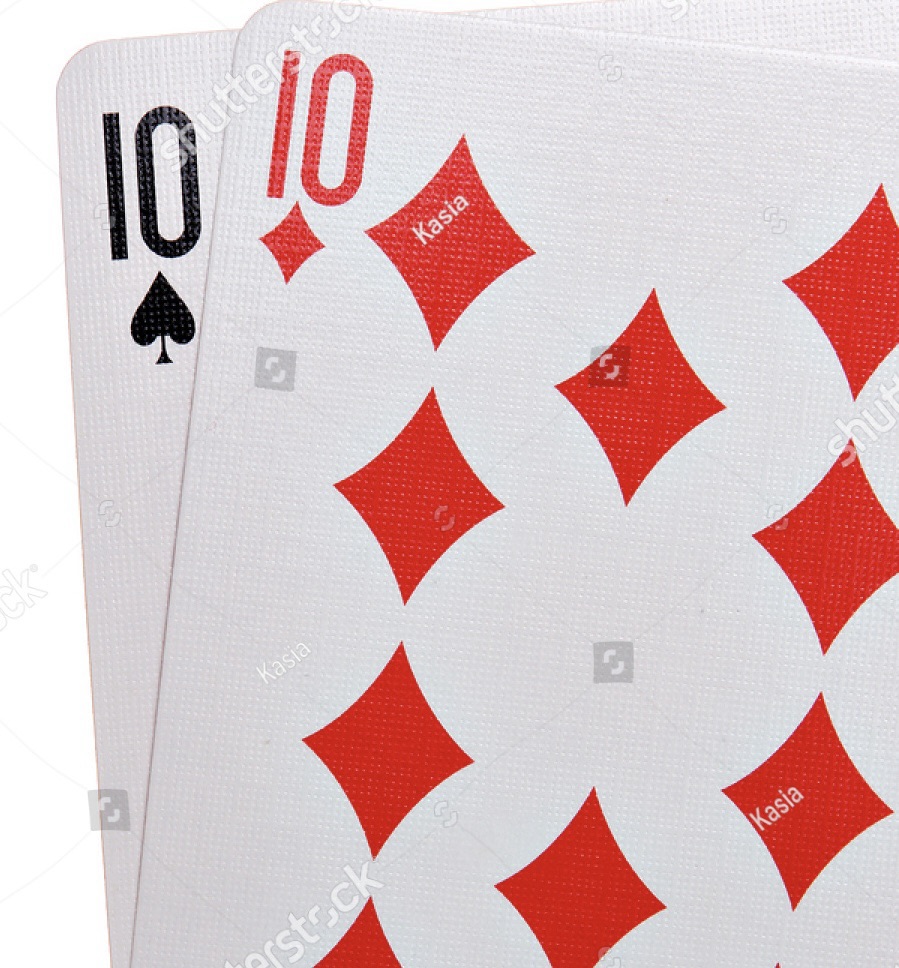
Sometimes the best poker move is the one you make before your opponent has time to think.
In this $1/$3 No-Limit Texas Hold’em hand, “Dimes” picks up pocket tens (TT) in the cutoff with about $165 behind. The small blind, holding A-K offsuit, is known as a maniac and has roughly $400. Dimes raises to $12 preflop, and the small blind makes the call.
The flop comes J-4-2 rainbow. Not exactly a scary board for pocket tens, but there is a problem: Dimes knows the player in the small blind is capable of making aggressive and unpredictable plays. Rather than allowing AK to see another card cheaply—or giving the maniac an opportunity to make a move—Dimes quickly moves all-in for roughly $153.
Maybe the shove came a little too quickly. Dimes later admitted the thought was essentially, “Get him out of here before he decides to do something crazy.” Instead, the maniac goes into the tank for nearly two minutes before finally making the call with A-K high.
Now Dimes has to sweat it out.
The Q♥ hits the turn, creating a brief moment of panic. But the river brings another J, pairing the board and leaving pocket tens ahead. Dimes doubles up to roughly $330.
The Poker Lesson
The lesson isn’t that you should automatically shove pocket tens on every J-4-2 flop. The important factors were stack size, opponent tendencies, and table dynamics.
Against a predictable player, there may be plenty of reasons to take a slower approach. Against a maniac with a wide range, however, putting maximum pressure on a relatively dry board can sometimes prevent your opponent from turning a missed hand into a difficult decision for you.
The other interesting question is whether Dimes shoved too quickly. Speed can sometimes reveal confidence, but it can also look suspiciously like a player who desperately wants a call to disappear.
Either way, the plan worked.
Dimes shoved. AK called. The tens held.
Sometimes poker doesn’t require magic.
Sometimes you just need Dimes. 🃏💰
If you enjoyed this post please share,like, comment, and subscribe. Please take a minute and click our our sponsor ads to show your support and keep our articles free. Thank you for reading and I’ll see you at the tables!
Favorite Poker Hand Nicknames
Every player every home game has different nicknames for Poler hands. Did I miss any? What are your favorites?
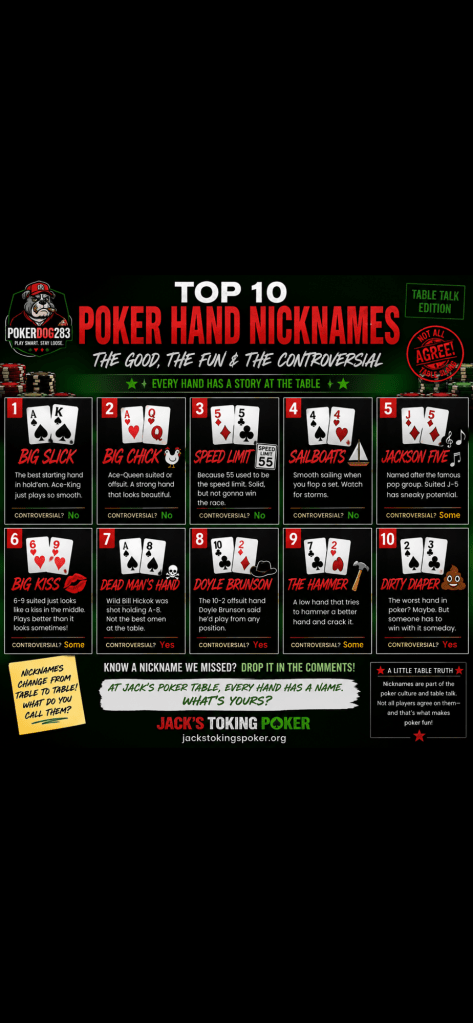
🩲 Hand of the Day: The Dirty Diaper vs. Pocket Kings
$1/$3 No-Limit Texas Hold’em
Sometimes the ugliest hand at the table makes the prettiest money.
Pocket Kings is sitting under the gun +1 with about $500 and decides to creep into the pot with a minimum raise. The Big Blind looks down at the 2♠3♠, sitting with about $210, and decides to defend.
The flop comes 4♦ 6♦ J♣. The BB checks, and KK fires $25. The BB tanks before making the call. Then comes the 5♥ on the turn—exactly the kind of card the Dirty Diaper was hoping to see. The BB checks again, and KK makes an unusual-looking $73 bet. Odd-numbered bets can sometimes look intimidating, but the BB isn’t going anywhere. After another tank, the BB flat-calls.
The river is the Q♣. KK checks, apparently ready to control the pot. That’s when the BB decides it’s time to pull the trigger and shoves all-in. KK doesn’t hesitate and snap-calls.
The BB turns over 2♠3♠.
A five-high straight.
KK is stunned.
And the winning player delivers the perfect explanation:
“Well… it was suited.”

🧠 The Lesson
Never underestimate what can happen when a player gets the right price to see a flop and is willing to stay patient. The 2♠3♠ looked like a garbage hand preflop, but the flop and turn created the perfect opportunity to keep applying pressure and eventually get paid.
And sometimes, in poker, the hand that looks like a dirty diaper ends up cleaning out the table.
What would you have done with the pocket Kings on the river?
If you enjoyed this article please like, share, comment,and subscribe. Be sure to click on our sponsor links to keep this blog free. Thanks for reading and I’ll see you at the tables!
🃏 Hand of the Day: When Pocket Kings Walked Into a Flush
$1/$2 No-Limit Texas Hold’em
Hero: $225
Villain: $415
Hero: A♥3♥
Villain: K♠K♦
Flop: K♥ 7♥ 4♥
Villain raises to $16 preflop, and Hero calls from the small blind with A♥3♥.
The flop comes K♥ 7♥ 4♥.
Villain has flopped three kings, an incredibly strong hand. But Hero has something even better — the nut flush.
Hero decides to continue calling Villain’s bets rather than immediately revealing the strength of the hand. Villain keeps applying pressure, apparently believing his set of kings is still the best hand.
The turn and river bring no card that changes the winner, and Hero continues to let Villain put money into the pot.
Then comes the river.
Hero moves all-in.
Villain is faced with a decision for Hero’s remaining stack. With $225 to start the hand and having invested money throughout the hand, Villain eventually calls.
Hero turns over A♥3♥.
The nut flush wins!
Hero doubles the original $225 stack and walks away with a very memorable pot.
💡 The Poker Lesson
This is a great example of why playing the strength of your hand doesn’t always mean betting big immediately.
Hero flopped the nuts but didn’t need to scare Villain away. By calling rather than raising, Hero allowed Villain’s confidence in his three kings to work against him.
For Villain, the lesson is equally important: a set is a monster hand, but a monotone board demands caution. When three cards of the same suit are sitting on the flop, your opponent’s range can contain a lot of flushes.
And for Hero, there’s a little bit of poker psychology here too: sometimes letting your opponent do the betting for you is the best way to build a pot.
The Player in Seat 4 at jackstokingspoker.org: Sometimes the best trap is simply letting your opponent think they’re the one holding the monster.
If you enjoyed this article please like, share, comment and subscribe. Please click on our sponsor ads to keep our articles free. Thank you for reading and I’ll see you at the tables!
$2/$5 NL Hold’em Bankroll Management: Protect Your Poker Money
Playing $2/$5 No-Limit Texas Hold’em requires more than good cards and solid strategy—it requires proper bankroll management. Unlike $1/$2, the swings at $2/$5 can become significant very quickly. A $500 buy-in may disappear in one hand, and a few losing sessions can put a serious dent in your poker funds. As a general guideline, a regular $2/$5 player should consider having 30–50 buy-ins available. If you normally buy in for $500, that means roughly $15,000–$25,000 dedicated specifically to poker.
Your poker bankroll should be money you can afford to lose without affecting your everyday life. Don’t include rent, mortgage payments, emergency savings, or money needed for bills. It’s also important to separate your session bankroll from your overall bankroll. You might bring $1,000 or $1,500 to the table, but that doesn’t mean you only have that amount available for poker. Setting reasonable limits before you play can also help prevent chasing losses. If you’re down several buy-ins and find yourself playing emotionally rather than making good decisions, it’s probably time to step away.
One of the biggest bankroll mistakes is moving up in stakes too quickly. Running $500 into $2,000 during one great $2/$5 session doesn’t mean you’re ready for $5/$10. Likewise, losing a few sessions doesn’t necessarily mean you’re a bad $2/$5 player. Poker has tremendous short-term variance, so you need to judge your results over a meaningful sample. If your bankroll drops below the level you’re comfortable with, moving temporarily back to $1/$2 isn’t failure—it’s smart bankroll management. Your goal isn’t to prove you belong at a certain stake; your goal is to make profitable decisions and stay in the game.
The most important rule is simple: never play a stake where a normal losing streak can hurt you financially. Track your buy-ins, cash-outs, hours, and results so you can see how you’re actually performing over time. A properly managed bankroll also gives you something extremely valuable at the poker table: confidence that you can withstand the inevitable bad beats and losing sessions. At $2/$5, protecting your bankroll is just as important as knowing when to bet, raise, or fold. Play within your bankroll, stay disciplined, and let the long run work in your favor.
Playing $2/$5 No-Limit Texas Hold’em requires more than good cards and solid strategy—it requires proper bankroll management. Unlike $1/$2, the swings at $2/$5 can become significant very quickly. A $500 buy-in may disappear in one hand, and a few losing sessions can put a serious dent in your poker funds. As a general guideline, a regular $2/$5 player should consider having 30–50 buy-ins available. If you normally buy in for $500, that means roughly $15,000–$25,000 dedicated specifically to poker.
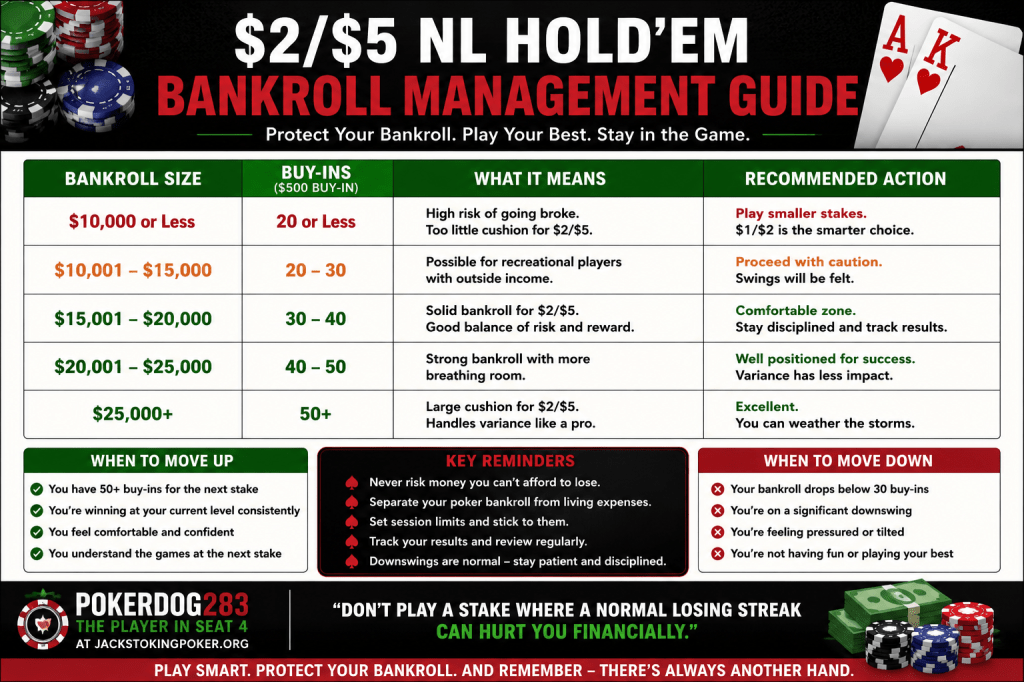
.Your poker bankroll should be money you can afford to lose without affecting your everyday life. Don’t include rent, mortgage payments, emergency savings, or money needed for bills. It’s also important to separate your session bankroll from your overall bankroll. You might bring $1,000 or $1,500 to the table, but that doesn’t mean you only have that amount available for poker. Setting reasonable limits before you play can also help prevent chasing losses. If you’re down several buy-ins and find yourself playing emotionally rather than making good decisions, it’s probably time to step away.
One of the biggest bankroll mistakes is moving up in stakes too quickly. Running $500 into $2,000 during one great $2/$5 session doesn’t mean you’re ready for $5/$10. Likewise, losing a few sessions doesn’t necessarily mean you’re a bad $2/$5 player. Poker has tremendous short-term variance, so you need to judge your results over a meaningful sample. If your bankroll drops below the level you’re comfortable with, moving temporarily back to $1/$2 isn’t failure—it’s smart bankroll management. Your goal isn’t to prove you belong at a certain stake; your goal is to make profitable decisions and stay in the game.
The most important rule is simple: never play a stake where a normal losing streak can hurt you financially. Track your buy-ins, cash-outs, hours, and results so you can see how you’re actually performing over time. A properly managed bankroll also gives you something extremely valuable at the poker table: confidence that you can withstand the inevitable bad beats and losing sessions. At $2/$5, protecting your bankroll is just as important as knowing when to bet, raise, or fold. Play within your bankroll, stay disciplined, and let the long run work in your favor.
If you enjoyed this article please like, share, comment and subscribe. Don’t forget to click on our sponsor ads that help us to keep the articles coming! Thank you for reading and I’ll see you at the tables!
Video Poker Strategy: How to Play Video Poker and Make Smarter Decisions at the Machine
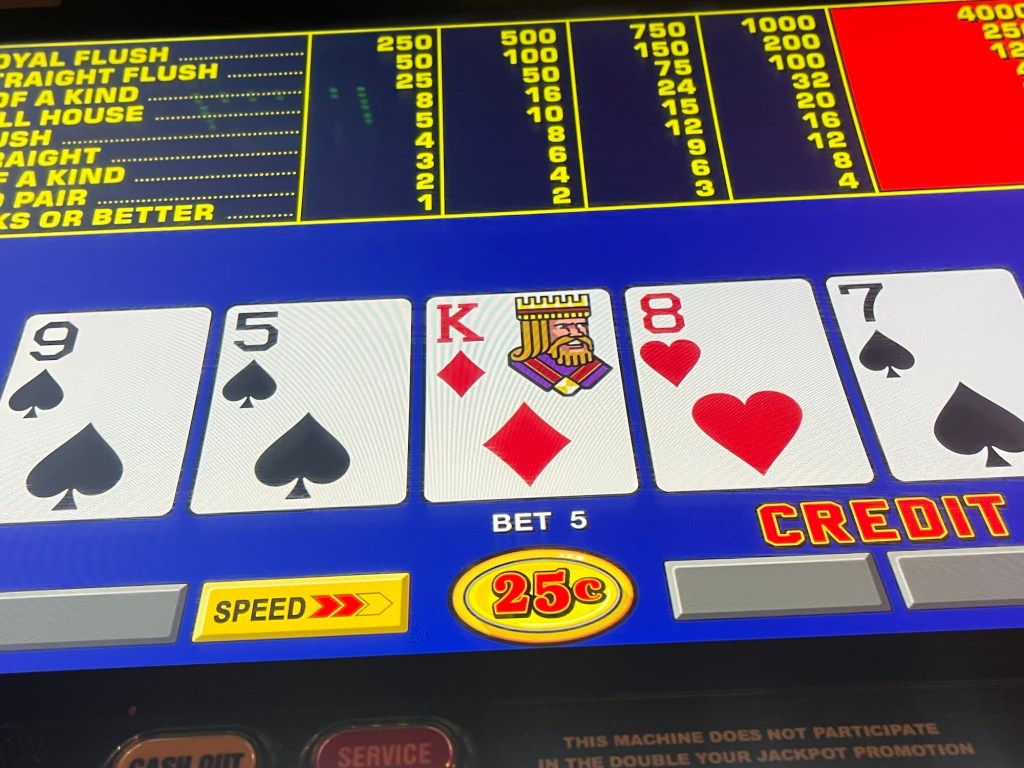
Video poker can look a lot like a slot machine, but there is one huge difference: you make decisions.
Instead of simply pressing a button and hoping for a winning combination, you are dealt a hand of cards and must decide which cards to keep and which to discard. That’s the foundation of any good video poker strategy.
At jackstokingspoker.org, we focus on making better decisions at the poker table. The same idea applies here. If you understand how to play video poker and apply a solid strategy, you can reduce the house edge and play much more effectively.
Start With the Right Game: Jacks or Better Strategy Basics
Not all video poker machines are created equal.
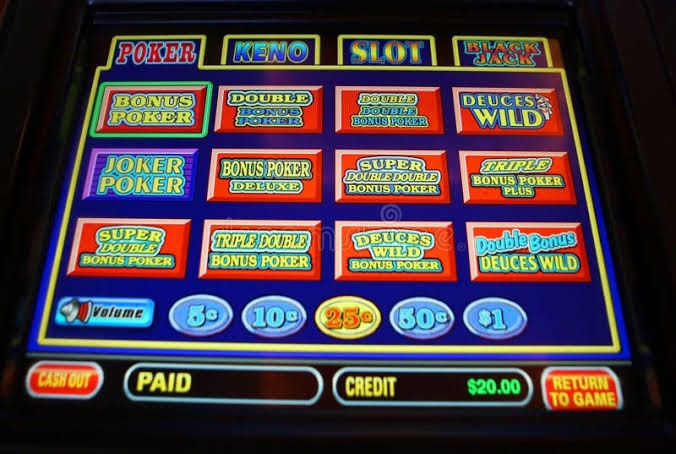
Before you put money into a machine, check the pay table. Different machines can have very different payouts, and that directly affects your long-term results.
For beginners, Jacks or Better strategy is the best place to start. It’s the most straightforward version of video poker and teaches strong fundamentals.
The goal is simple: finish with at least a pair of jacks, queens, kings, or aces — or build stronger poker hands like two pair, three of a kind, straights, flushes, full houses, four of a kind, straight flushes, or the royal flush.
The Core Video Poker Strategy: Keep Strong Hands
One of the biggest beginner mistakes in how to play video poker is overthinking strong hands.
If you are dealt a strong made hand, you usually keep it.
For example:
A♠ A♥ 7♣ 4♦ 2♠
Keep the two aces.
You already have a winning pair, so breaking it up in hopes of something better is usually a mistake in basic video poker strategy.
Likewise, if you are dealt a straight, flush, or full house, you should almost always keep the entire hand.
Don’t Automatically Chase a Royal Flush
The royal flush is the dream hand in video poker, but chasing it blindly is not part of good strategy.
Imagine you are dealt:
K♠ 9♦ 6♣ 3♥ 2♦
There is no real draw here. Keeping the king just because you hope to build a royal flush is not correct video poker strategy.
Good play is based on math, not hope. Learning how to play video poker properly means knowing when not to chase unlikely outcomes.
Learn the Value of Pairs in Jacks or Better Strategy
In Jacks or Better strategy, a pair of jacks or higher is a paying hand, which makes it very important.
For example:
A♣ A♦ 8♠ 6♥ 3♣
Keep the aces.
But a hand like:
10♠ 10♦ 7♣ 4♥ 2♦
requires more attention because tens are not a paying pair in Jacks or Better. This is where a basic strategy chart becomes extremely useful for improving your video poker strategy.
Don’t Forget About Four-Card Draws
Sometimes the best play in how to play video poker isn’t a made hand — it’s a strong draw.
For example:
10♠ J♠ Q♠ K♠ 4♦
You have four cards to a royal flush.
Keeping those four suited cards gives you a real chance to hit the strongest hand in the game. This is one of the most exciting parts of video poker strategy: you are making decisions before the final card is revealed
.

Bet Consistently for Better Video Poker Strategy
Another key part of video poker strategy is consistency.
Avoid changing your bet size based on short-term results.
Decide on a bankroll and denomination before you start. For example, if you’re playing a $0.25 machine, set a clear budget before you sit down.
Don’t chase losses by increasing your wagers. That’s one of the fastest ways to lose control of your session.
Bankroll Management Is Part of How to Play Video Poker
Even with perfect video poker strategy, you will still have losing sessions. That’s just part of the game.
That’s why bankroll management is essential.
Set a loss limit before you play and stick to it. If you reach it, walk away.
And if you’re ahead, don’t let that change your discipline. Good Jacks or Better strategy is about long-term consistency, not short-term emotion.
The Bottom Line: Video Poker Strategy Is About Better Decisions
Learning how to play video poker isn’t about finding a trick that guarantees wins.
It’s about making better decisions over thousands of hands.
Start with a good-paying machine, learn Jacks or Better strategy, understand which hands to keep, and manage your bankroll responsibly. That’s the foundation of strong video poker strategy.
At jackstokingspoker.org, we believe in one simple idea:
Better decisions lead to better results.
If you’re also working on your Texas Hold’em game, video poker is a great way to sharpen your understanding of hand values, probabilities, and decision-making.
Want to improve your poker game? Keep following jackstokingspoker.org — The Player in Seat 4 is always looking for the next edge.
Video Poker Strategy Cheat Sheet (Quick Reference)
● Always keep paying pairs (Jacks or better in Jacks or Better games)
● Always keep made strong hands: two pair, three of a kind, straights, flushes, full houses, quads, straight flushes
● Always keep four to a royal flush (same suit: 10-J-Q-K-A)
● Prefer high cards over low unsuited cards when no made hand exists
● Discard weak, unsuited low cards (especially 2–9 with no draw potential)
● Do not break strong hands chasing unlikely draws
● Do not chase royal flushes without a real draw
● Keep high pairs over drawing hands in most cases
● Follow a basic strategy chart for Jacks or Better for optimal play
In my next post I will provide a simple to memorize or print basic strategy guide!
If you enjoyed this article please like, share. Comment and subscribe. Please click on our sponsor ads to keep our blog free. Thanks for reading and I’ll see you at the tables!
🃏 Hand of the Day: Pocket Aces Go Unchallenged on the Turn
Hand of the Day: Pocket Aces Turn Shove Wins Without a Showdown
There are few better starting hands in Texas Hold’em than pocket aces.
But getting dealt AA is only the beginning. The real challenge is figuring out how to get maximum value while protecting yourself when the board starts getting dangerous.
Today’s Hand of the Day is a great example.
I picked up A♠A♥ and watched the action develop.
The first player raised to $20.
A second player made it $40.
When the action got to me, I decided to flat call.
We went to the flop three-handed.
Pre-Flop
Player 1: $20
Player 2: Raises to $40
Hero: Calls $40 with pocket aces
The flop came:
9♣ 6♦ 4♥
Not a bad flop for pocket aces.
There wasn’t an immediate flush draw, although the connected cards created some straight possibilities.
The first player to act bet $60.
The second player called.
I looked down at my pocket aces and decided to flat call again.
At this point, I wasn’t interested in blowing up the pot unnecessarily. I was happy to allow my opponents to continue putting money into the middle.
Flop Action
Player 1: Bets $60
Player 2: Calls $60
Hero: Calls $60
Then came the card that changed the hand.
5♣
The board was now:
9♣ 6♦ 4♥ 5♣
Suddenly, the board was much more dangerous.
Straight possibilities were developing, and the second club created potential flush draws.
The original bettor fired another $60.
The next player called.
Now the action was back to me.
I had a decision.
Call?
Raise?
Or put maximum pressure on both players?
I chose the third option.
ALL IN.
I shoved my entire stack into the middle.
The Tank
Both players went into the tank.
And the second player really went into the tank.
Approximately five minutes.
That’s a long time to make a poker decision.
Eventually, both players folded.
The pot was mine.
No showdown.
No river.
No sweat.
The One-Ace Reveal
After both players folded, I decided to show one ace.
Then I mucked the other.
They never got to see the complete hand.
Sometimes in poker, you don’t have to show the whole story.
You just have to tell enough of it.
What Can We Learn From This Hand?
1. Don’t Automatically Slow Down With AA
Pocket aces are the best starting hand in Texas Hold’em, but they aren’t invincible.
The board changes.
Your opponents’ ranges change.
And your strategy needs to change with them.
2. Pay Attention to Turn Cards
The 5♣ wasn’t necessarily a terrible card for pocket aces, but it made the board considerably more connected.
Straight draws and flush draws were now much more relevant.
Giving opponents another cheap card wasn’t particularly appealing.
3. Sometimes Calling Is Better Early
Pre-flop, I could have put in another raise.
On the flop, I could have raised the $60 bet.
Instead, I called.
That kept my opponents involved and allowed them to continue betting.
Then, when the board became more dangerous, I changed gears.
4. Put Difficult Decisions on Your Opponents
The all-in shove forced both players to make a major decision.
They had already invested money.
They had draws and potential made hands to consider.
But now they had to risk their entire stack.
Neither player was willing to do it.
That’s the power of pressure in poker.
The Final Verdict
Pocket aces.
Three players to the flop.
9♣ 6♦ 4♥.
5♣ turn.
Two bets and a call.
Then the shove.
Both opponents folded.
One opponent tanked for five minutes before finally letting the hand go.
And pocket aces never had to see a river.
Hand of the Day Takeaway
Don’t fall in love with your starting hand.
Pocket aces may be the best starting hand in poker, but good players don’t just play their cards — they play the board, the betting action and their opponents.
Sometimes the best way to win with pocket aces isn’t to show them at showdown.
Sometimes it’s to make everyone else fold.
That’s exactly what happened here.
Starting Hand: ⭐⭐⭐⭐⭐
Flop: ⭐⭐⭐⭐⭐
Turn: ⚠️ Dangerous
Decision: 💥 All-in
Result: 🏆 Everyone folds
Showdown: None needed
Would you have shoved the turn, or would you have just called?
If you enjoyed this article please like, share, comment and subscribe. Please click on our sponsor links to keep this blog free. Thanks for reading and I’ll see you at the tables.
Atlantic City trip to Tropicana: August 2026 Day 1
So it’s Dukes birthday and we decided to go to the beach for a few days and river tubing and why not spend a couple days in AC? My amazing wife found an outdoor bounce park on the bay in Margate so all of our kids decided to go! They haven’t really been to AC before so we booked at Tropicana, it’s my new favorite and probably the most Children friendly in my opinion!
We visit Cesar’s properties quite a bit so we were able to get 2 rooms for 2 nights for about $200 since even though we receive comped rooms you still need to cover the taxes and resort fees.
When arrived at 200 we were ready to check in, took like 15 minutes because I wanted to hit the desk and ensure rooms that were adjoining if possible. Otherwise it takes almost seconds with their quick kiosks!
We dropped off our bags and freshened up great ocean view and headed to get something to eat. Tropicana has a great selection of restaurants and an afford court, so it’s actually exciting just to eat! They have Carmines, PF Changs, other high end choices and tucked away I think is the last “Good “ Hooters, several food court choices and my favorite Casa and Tequila Bar! I think my children were overwhelmed so after an eternity of discussion we all agreed on Taco and Tequila. It’s close to the boardwalk and they wanted to explore! Meal as usual was fantastic and the service was great only issue is we can’t get reward points from eating there.


We took the kids on to the boardwalk checked out the beach stopped for candy at Sugar and walked as far as they wanted till their feet hurt and needed to tram car back!

We got back to the room about 930pm and I decided it was time to play cards. Since Tropicana is one of the few places left with a poker room I decided to play there! Great time great action and good play. I made a few bad decisions early actually I got called by a couple of worse hands that hit but sometimes that’s the game and was down to about $70 from my $240 start. I later hit some great hands. Doubled up with jacks then almost tripled up from a huge hand with big raises till I shoved with Rockets after the turn opponent bet out $60, a caller behind him and I shoved putting them both in the tank, one for 5 minutes obv both were on big draws. I ended up leaving at 200m with about $500 bucks as the game started to slow up.


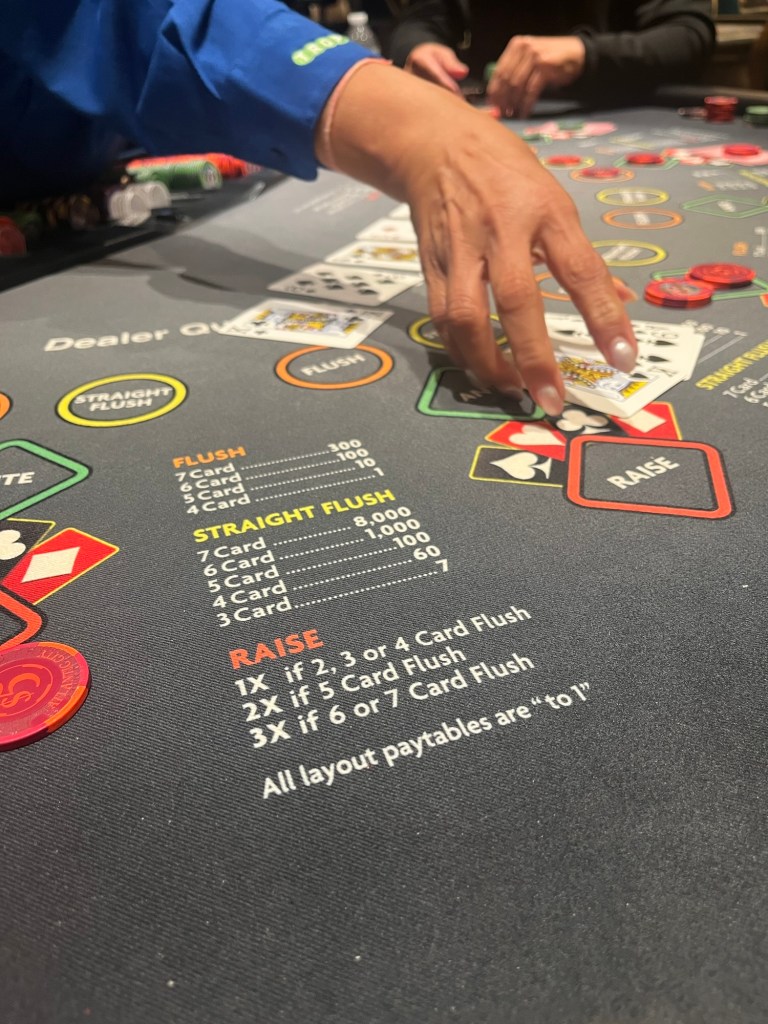
I decided it was time to head to the room but unfortunately for me I walked through the table games! I bought in for $300 on Top Flush and after an hour I had busted, telling me it was definitely bed time. I couldn’t hit a hand to save my life!
Day 2 publishing soon. If you enjoyed this article please like, share, subscribe, comment. Please click on our sponsor links to help keep our blog free! Thanks for reading and I’ll see you at the tables!
Texas Holdem VS. Pot Limit Omaha!
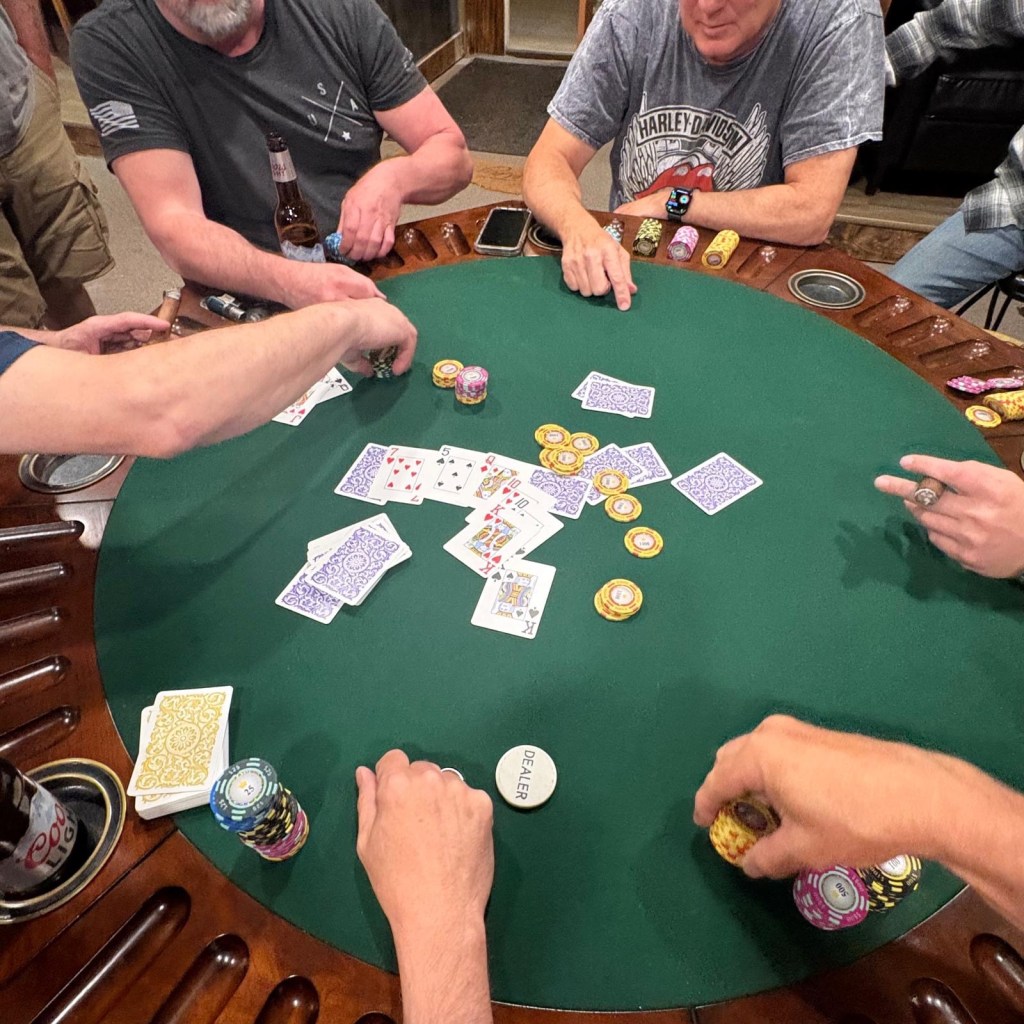
Walk into almost any poker room today, and you’ll find two games dominating the action: Texas Hold’em and Pot Limit Omaha (PLO).
Both games use community cards. Both require skill, patience, and strategy. Yet the similarities stop there.
While Texas Hold’em is known for calculated aggression and straightforward hand reading, Pot Limit Omaha is a game of massive draws, big pots, and constant action.
So which game is right for you?
Let’s compare the two and see what makes each unique.
Texas Hold’em: The World’s Most Popular Poker Game
Texas Hold’em remains the most popular poker variant in the world—and for good reason.
Each player receives two private hole cards, followed by five community cards. Players make the best five-card hand using any combination of those cards.
Hold’em is easy to learn but incredibly difficult to master.
It rewards patience, discipline, position, and strong decision-making.
For beginners, Texas Hold’em is usually the best place to start because the rules are simple and hand values are easier to understand.
Pot Limit Omaha: More Cards, More Action
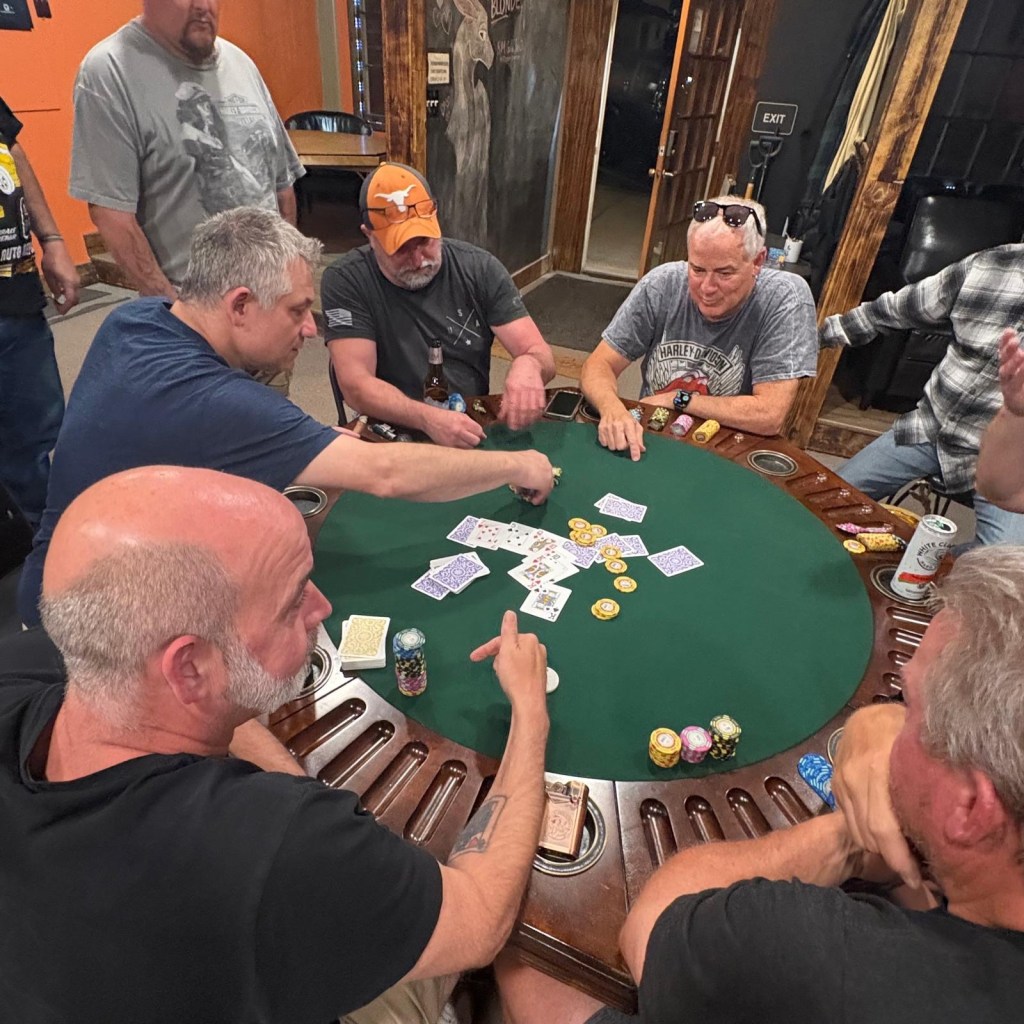
Pot Limit Omaha raises the excitement immediately.
Instead of two hole cards, every player receives four hole cards.
However, there’s one rule every new player must remember:
You must use exactly two of your hole cards and exactly three community cards to make your final hand.
That single rule changes everything.
Because players have four hole cards, they make stronger hands much more often than in Hold’em.
Straights, flushes, full houses, and monster combination draws become common.
If you enjoy action, you’ll probably love PLO.
Starting Hands Matter Differently
In Texas Hold’em, premium starting hands like pocket Aces, Kings, and Ace-King dominate before the flop.
In Pot Limit Omaha, premium hands are built around coordination.
The strongest PLO hands contain connected cards, suited cards, and multiple ways to improve after the flop.
For example:
Strong Hold’em Hand
● A♠ A♥
Strong PLO Hand
● A♠ A♦ K♠ Q♦ (double suited)
Notice the difference?
In Omaha, all four cards need to work together.
Big Hands Happen More Often
One of the biggest shocks for Hold’em players is how often huge hands appear in Omaha.
Top pair that wins comfortably in Hold’em is often worthless in PLO.
Even top set can become vulnerable on coordinated boards.
The winning hand in Omaha is frequently the nuts—the best possible hand.
If you consistently chase second-best hands, Omaha will quickly teach you an expensive lesson.
Betting Structures
Texas Hold’em is most commonly played as No-Limit Hold’em, allowing players to bet all of their chips at any time.
Pot Limit Omaha uses a different betting structure.
The maximum bet is the size of the current pot.
This changes strategy significantly.
Instead of relying on all-in pressure, PLO players focus on building pots, maximizing value, and making disciplined decisions over multiple betting streets.
Variance: Prepare for Bigger Swings
Both games have variance.
Pot Limit Omaha simply has more of it.
Because draws often have substantial equity against made hands, even favorites lose more frequently than many Hold’em players expect.
That doesn’t mean Omaha is luck-based.
It means bankroll management becomes even more important.
Successful PLO players understand that short-term swings are part of the game.
Which Game Requires More Skill?

Poker players have debated this question for years.
Texas Hold’em places a premium on reading opponents, understanding ranges, bluffing, and extracting value with thinner edges.
Pot Limit Omaha demands exceptional hand selection, board reading, equity evaluation, discipline, and an understanding of complex post-flop situations.
Neither game is “easy.”
They simply challenge different poker skills.
The best players often study and enjoy both.
Which Game Should You Play?
Choose Texas Hold’em if you:
● Prefer a slower, more strategic pace.
● Enjoy bluffing and reading opponents.
● Are new to poker.
● Want the widest variety of games and tournaments.
Choose Pot Limit Omaha if you:
● Love action-packed poker.
● Enjoy drawing hands and complex decisions.
● Like deeper post-flop strategy.
● Don’t mind larger bankroll swings.
Many players begin with Hold’em before adding Omaha to their skill set, giving them a broader understanding of poker strategy.
Final Thoughts from The Player in Seat 4
Texas Hold’em and Pot Limit Omaha are both fantastic games, but they reward different approaches.
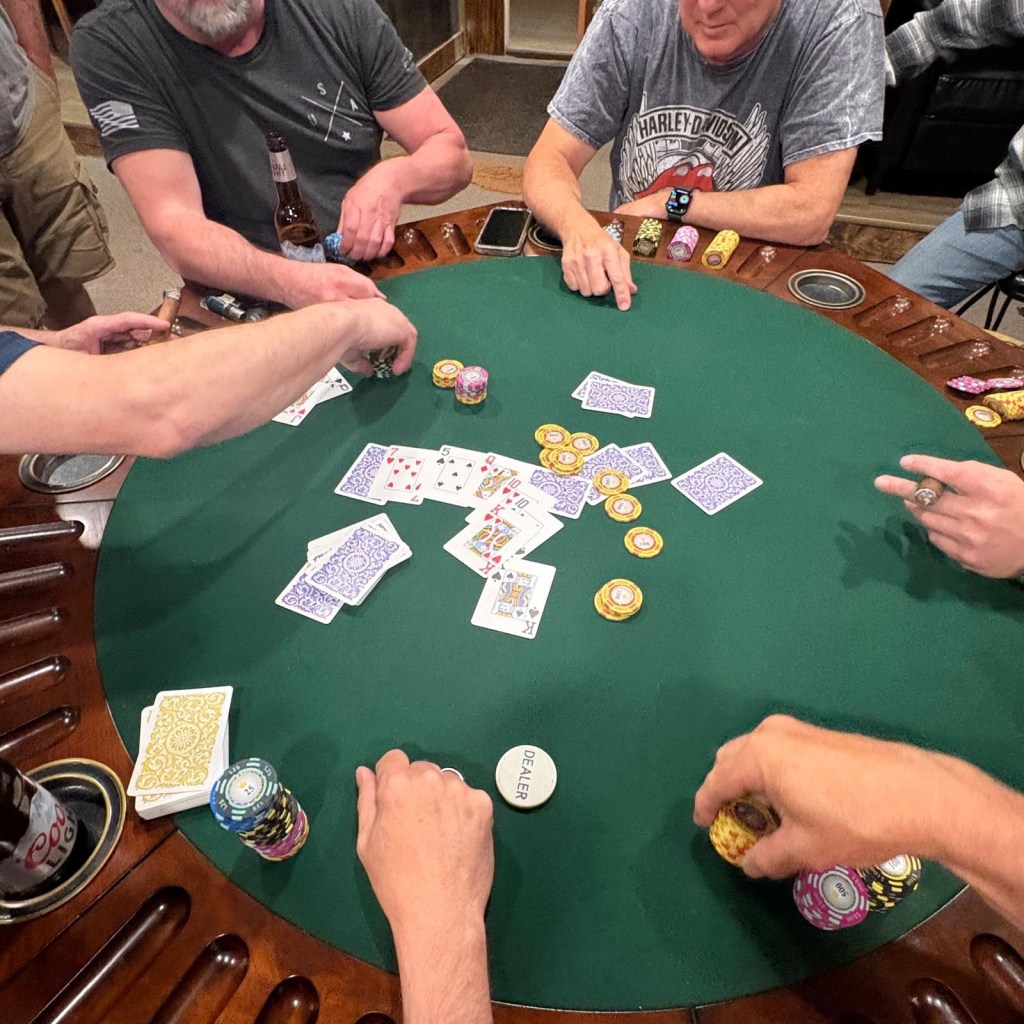
Hold’em is often a game of patience, precision, and calculated aggression.
Pot Limit Omaha rewards coordinated starting hands, nut potential, position, and disciplined post-flop play.
If you’ve never tried PLO, give it a chance. Just don’t expect your Hold’em instincts to translate perfectly.
The players who adapt, continue learning, and respect the differences between the two games are usually the ones stacking chips at the end of the night.
Whether you’re grinding a $1/$2 cash game, chasing tournament glory, or simply looking to improve your overall poker skills, learning both formats will make you a more complete player.
Key Takeaways
● Texas Hold’em uses 2 hole cards; Pot Limit Omaha uses 4 hole cards.
● In PLO, you must use exactly 2 hole cards and 3 community cards.
● Omaha produces stronger hands and larger pots more often.
● Hold’em rewards patience and reading opponents.
● PLO rewards coordinated hands, nut potential, and disciplined post-flop decisions.
● Mastering both games will strengthen your overall poker success
If you enjoyed this article please like, share, comment and subscribe. Please take a second and click on our advertiser links to keep these articles free. Thanks for reading and I’ll see you at the tables!
Stop Losing at Pot Limit Omaha! The 10 Biggest Mistakes Texas Hold’em Players Make in PLO

If you’ve spent years crushing Texas Hold’em and think you’ll automatically dominate Pot Limit Omaha (PLO), think again.
Every day, experienced Hold’em players sit down in a PLO game convinced they’re bringing a huge edge to the table. A few hours later, they’re wondering where their bankroll went.
The truth is simple: Pot Limit Omaha is an entirely different game.
The skills you’ve developed playing Hold’em certainly help, but many habits that make you a winning Hold’em player can become costly mistakes in PLO.
If you’re making the transition, avoid these ten common mistakes and you’ll give yourself a much better chance of becoming a winning Omaha player.
1. Overvaluing Pocket Aces
In Texas Hold’em, pocket aces are the undisputed king of starting hands.
In Pot Limit Omaha, they’re only as good as the other two cards.
A hand like A♠ A♥ K♠ Q♥ double-suited is a monster because it has premium flush and straight potential.
A hand like A♠ A♦ 7♣ 2♥ rainbow? Not nearly as exciting.
Many Hold’em players stack off simply because they have aces.
In Omaha, always evaluate all four cards—not just the pair.
2. Playing Too Many Starting Hands
Four hole cards create endless possibilities.
Unfortunately, they also create endless bad decisions.
Many Hold’em players believe that four cards automatically mean more playable hands.
Wrong.
Winning PLO players are selective. They look for hands that work together with connected cards, suited combinations, and nut-making potential.
Disconnected hands belong in the muck.
3. Falling in Love with Top Two Pair
Top two pair is often a powerhouse in Hold’em.
In Omaha?
It’s frequently a bluff catcher.
Because every player starts with four cards, strong made hands happen much more often. Sets, straights, bigger two-pair combinations, and monster draws are everywhere.
If you’re stacking off with top two pair in PLO, prepare for some expensive lessons.
4. Chasing Non-Nut Draws

may be the biggest adjustment for Hold’em players. Second-best flushes.
Bottom ends of straights.
Weak full houses.
These hands often lose huge pots.
Winning PLO players constantly ask themselves:
“Am I drawing to the nuts?”
If the answer is no, proceed carefully.
5. Ignoring Position
Position is valuable in every form of poker.
In Pot Limit Omaha, it becomes even more important.
The extra combinations mean more difficult decisions on every street.
Playing in position allows you to gather information before risking chips.
Playing out of position forces you to guess.
Good Omaha players guess less.
6. Overplaying Sets
Flopping top set feels incredible.
Until the board runs out:
9♠ 10♠ J♦ Q♣ K♠
Welcome to Omaha.
Sets remain strong, but they become vulnerable very quickly on coordinated boards.
Always ask yourself what draws your opponents could realistically have.
7. Ignoring Board Texture
Hold’em players often think:
“I have top set.”
Omaha players think:
“What does this board hit?”
Every flop should trigger questions.
Is it coordinated?
Are flushes possible?
How many straight combinations exist?
Could multiple players have monster draws?
Reading board texture separates winning PLO players from losing ones.
8. Betting Like It’s No-Limit Hold’em
PLO uses pot-limit betting.
That changes strategy dramatically.
You cannot pressure opponents by moving all-in whenever you choose.
Instead, successful players build pots strategically over multiple streets while paying close attention to stack-to-pot ratios.
Learning proper pot control is a huge step toward becoming a winning Omaha player.
9. Underestimating Variance
Even when you’re a favorite, you’ll lose.
Often.
Monster draws frequently have significant equity against made hands.
That means swings are much larger than many Hold’em players expect.
Don’t panic after a losing session.
Stick to sound strategy and protect your bankroll.
10. Refusing to Adapt
This is the mistake that ties all the others together.
Too many players try to force Hold’em strategy into an Omaha game.
PLO rewards flexibility.
It rewards patience.
It rewards discipline.
The sooner you stop thinking like a Hold’em player, the sooner you’ll start winning at Omaha.
Final Thoughts from The Player in Seat 4

Pot Limit Omaha isn’t simply “Texas Hold’em with four cards.”
It’s a game built around nut hands, powerful draws, position, discipline, and careful hand selection.
The biggest winners in PLO aren’t always the most aggressive players—they’re the ones who consistently avoid expensive mistakes.
If you’re transitioning from Hold’em, take your time. Study the game, respect the action, and remember that every hand offers more possibilities—for both you and your opponents.
Master these ten adjustments, and you’ll already be ahead of many players making the same transition.
Join the Conversation
Which mistake do you see most often when Texas Hold’em players try Pot Limit Omaha? Share your thoughts in the comments!
For more strategy articles, cash game tips, tournament advice, and poker psychology, visit The Player in Seat 4 at jackstokingspoker.org.
If you enjoyed this article please like, comment, share and subscribe. Please click on our sponsor ads to keep our articles free. Thank you for reading and I’ll see you at the tables!




Recent Comments