Archive
Hand of the day: Pocket Aces walk into a Diamond Storm!

Some poker hands unfold slowly. Others explode instantly. Today’s $1/$2 cash‑game hand is the kind of cooler that reminds us how even the strongest starting hand in Hold’em can be helpless when the board decides otherwise.
Preflop
Hero picks up A♠ A♥ and raises to $25, a strong sizing that isolates and builds the pot. Villain calls in position with K♦ Q♦, a suited Broadway hand that plays beautifully with deep stacks.
Flop: A♦ 9♦ 8♦
The flop is a disaster disguised as a dream.
Hero flops top set.
Villain flops the nut flush.
On a monotone board like this, sets are still extremely strong, and many worse hands can continue. Hero shoves all‑in, looking to deny equity and get value from dominated holdings. Villain snap‑calls with the nuts.
Runout
The turn and river brick out. K♦ Q♦ holds, and the pot slides to Villain.
Takeaways
- Pocket aces are powerful preflop, but monotone boards can flip the script instantly.
- Sets remain strong holdings, and jamming isn’t a mistake here — it’s simply a cooler.
- Suited Broadway hands in position can apply enormous pressure and realize equity well.
- Sometimes the deck writes a tragedy, and all you can do is turn the page.
Suited Connectors vs Pocket 5s Good or bad move?
🃏 Hand of the Day: Suited Connectors vs. the Small Blind Min‑Raise
Some hands are won or lost before the flop ever hits the felt. Today’s spot is a perfect example: the Small Blind min‑raises with pocket 5♠5♦, and Hero must decide whether calling with suited connectors is sharp or spewy.
Let’s break it down.
🎬 The Setup
Blinds are posted.
Villain is in the small blind holding pocket fives, a hand that loves to see flops but hates playing bloated pots out of position.
Villain chooses the modern low‑risk opener: a min‑raise.
Hero looks down at suited connectors Queen Jack of spades— hands built for deep stacks, position, and implied odds.
The question: Is calling the min‑raise a good decision?
🧠 Strategic Breakdown
🎯 Why Calling Is Usually the Correct Play
Against a small blind min‑raise, calling with suited connectors is often highly profitable:
- You have position: Acting last on every street is a massive edge.
- Your hand plays beautifully: Suited connectors make disguised monsters — straights, flushes, two‑pair.
- You attack a capped range: Pocket 5s struggle on most flops that aren’t 5‑high.
- You’re getting a great price: A min‑raise gives you excellent pot odds to peel.
This is exactly the type of spot where suited connectors quietly print money.
⚠️ When Calling Becomes Marginal
There are a few exceptions:
- Shallow stacks (20bb or less): You lose the implied odds that make suited connectors profitable.
- Villain is extremely tight: If the SB only raises premiums, your equity realization drops.
- You overplay weak pairs: Suited connectors require discipline — they’re not top‑pair hands.
But in a normal cash game or deep‑stacked tournament, the call is standard and strong.
🔍 Villain’s Perspective (Pocket 5s)
Pocket fives are awkward:
- Too good to fold
- Too weak to love big pots
- Vulnerable to almost every flop
- Easy to outplay from position
The min‑raise is fine, but it invites exactly the type of hand — suited connectors — that can make Villain’s life miserable postflop.
🏁 Verdict
Calling with suited connectors versus a small blind min‑raise is a good call — often a great one.
You’re in position.
You’re getting a price.
You have a hand that wins big pots and loses small ones.
And Villain’s pocket 5s are exactly the type of hand that struggles to navigate postflop pressure.
If you enjoyed this article, please like, comment share and subscribe. Thank you and see you at the tables!

Bluffing 101: A guide to bluffing in 2026
Bluffing in poker remains one of the most powerful — and most misused — tools in 2026. With solvers like GTO Wizard, PioSolver, and newer ones (PeakGTO, GTO Lab) widely available and more affordable than ever, the game has shifted dramatically. Many mid-to-high stakes players defend wider, call lighter with bluff catchers, and punish obvious aggression. Yet bluffing isn’t dead; it’s evolved. The best players bluff smarter, not more often, blending GTO frequencies with sharp exploits against the field.
Whether you’re grinding micro-stakes online, live $1/2 tables in Maryland, or dreaming of bigger games, here’s a practical, up-to-date guide to bluffing effectively in today’s environment.

1. Understand Modern Bluffing Fundamentals (GTO Baseline)
Solvers show bluffing isn’t about “tricking” people — it’s about balance and range advantage.
• Bluff-to-value ratio — On the river in polarized spots, bluff roughly enough so opponents are indifferent to calling with bluff catchers (often ~1 bluff per 2–3 value bets, depending on pot odds).
• Blockers matter hugely — Bluff with hands that block your opponent’s calling range (e.g., A-high bluffs block top pair Ax holdings).
• Board texture dictates frequency — Dry boards (like K72 rainbow) allow more bluffs because value ranges are narrow. Wet/coordinated boards require tighter bluffing.
• Overbetting is standard now — Big river overbets (1.5–2x pot) polarize your range: nuts or air. Use them with strong blockers and when your range looks stronger than villain’s.
In 2026, over-relying on max exploits (e.g., always bluffing stations) burns money against solver-trained regs. Instead, start close to GTO and deviate only when you have clear reads.
2. Best Spots to Bluff in 2026
Target these high-EV opportunities:
• Steal more preflop — 3-bet light wider from the big blind vs late-position opens (especially vs players who fold too much to 3-bets). Mix in some 4-bet bluffs with suited connectors/blockers.
• Float and turn bluff — Call flop with backdoor equity, then bet turn when checked to (classic BlackRain79-style play still crushes low-mid stakes).
• Probe bets / donk bluffs — On scary turn/river cards (e.g., flush completes), donk-lead small from out of position vs passive players who check back too much.
• Capped range exploits — When villain shows weakness (check-check flop/turn), barrel big on rivers where their range caps (no nuts possible).
• ICM pressure in tournaments — Multi-way or bubble spots = more bluffs with strong-but-not-nuts hands (turn missed draws into bluffs).
Avoid bluffing:
• Calling stations / loose players who “won’t fold pairs.”
• When your range is capped (e.g., you checked back flop).
• Into players who rarely bluff themselves (they call lighter to “keep you honest”).
3. Key Tips from Pros Working in 2026
• Table image is still king — If you’re running hot and showing value, your bluffs get through easier. If you’re the table maniac, tighten up — people snap-call.
• Bet sizing tells a story — Make bluffs look like value. Use the same sizes for bluffs and value (e.g., pot-sized on turn for both). In 2026 streams/home games, players notice inconsistent sizing fast.
• Timing tells — Quick bets often scream value or planned bluffs; delays can induce folds if you Hollywood.
• Don’t force it — Bluffing frequency should come from range construction, not ego. Many leaks come from “I need to bluff more” rather than “this spot is +EV.”
• Exploit less, but exploit better — As coaches like Filip Aleksić note, full GTO play beats over-exploiting in tougher fields. Use HUDs/stats to spot under-bluffers (call lighter) and over-bluffers (fold more bluff catchers).
4. Example Hand Breakdown (Modern River Bluff)
Imagine: 100bb effective, you raise BTN with Q♠J♠, BB calls.
• Flop: K♦7♣2♥ (dry) → You c-bet small (33%), BB calls.
• Turn: 4♠ (backdoor flush draw) → You check back (or small bet if aggressive).
• River: A♠ (flush completes, scary card).
Pot is bloated, villain checks. Your range hits the ace hard (AK, AQ), but you have Q-high with the blocker to AA/AK. Overbet jam here — villain folds tons of 88-JJ, weaker Ax that fears the flush. This is a classic polarized bluff that solvers love.
Final Thoughts for 2026
Bluffing wins pots you don’t deserve, but overdoing it kills win rates. Study solvers to learn frequencies, then watch opponents to exploit deviations. Track your red line (aggression without showdown) — if it’s bleeding, bluff less vs calling stations and more vs nits.
The meta keeps shifting toward balance, but human players still fold too much to pressure in the right spots. Master when to apply it, and you’ll keep stacking chips.
What kind of games are you playing most (online cash, live, MTTs)? Any specific bluff spot you’re struggling with? Drop it below — happy to break it down! ♠️
If you enjoyed this article please like, comment share and subscribe. Thanks and see you at the tables!
Understanding GTO in Poker:
What Is GTO in Poker? A Simple 2026 Beginner’s Guide

If you’ve been playing poker in 2026 — whether grinding online micro-stakes, hitting live tables in Vegas or watching streams — you’ve probably heard the term GTO thrown around. It stands for Game Theory Optimal, and it’s one of the biggest game-changers in modern poker.
But what does GTO actually mean? Let’s break it down simply, without the math overload.

GTO Poker Explained in Plain English
GTO is a perfectly balanced strategy that makes you unexploitable. No matter what your opponent does, they can’t gain a long-term edge over you just by adjusting to your play.
Think of it like this:
• In poker, if you bluff too much, opponents start calling lighter and crush you.
• If you never bluff, they fold to every bet and you miss value.
• GTO finds the exact mix of bluffs, value bets, calls, and folds so opponents are indifferent — they can’t profit by changing their strategy against you.
It’s like playing rock-paper-scissors where you randomize perfectly: no one can beat you consistently if you stick to the optimal frequencies.
In poker terms, GTO means:
• Betting the right amount of bluffs vs. value hands in every spot.
• Defending (calling/raising) the perfect percentage against bets.
• Building ranges (groups of hands) that are tough to attack.
The goal? Maximize your expected value (EV) in the long run, even against the best players.
GTO vs. Exploitative Play: Quick Comparison
Most pros in 2026 start with GTO as a baseline (to plug leaks), then deviate exploitatively when they spot clear weaknesses (like calling stations who never fold pairs).
Why GTO Matters So Much in 2026
Thanks to affordable, powerful solvers like GTO Wizard (the top tool right now), PioSolver, PeakGTO, and others, even mid-stakes players study GTO solutions daily. The meta has shifted: regs defend wider, call lighter with bluff-catchers, and punish unbalanced aggression.
If you’re not at least GTO-aware, you’re leaking money in tougher games.
How to Start Using GTO (Without Overwhelm)
1. Learn basics — Focus on preflop ranges first (charts show how often to raise/call/fold from each position).
2. Use tools — GTO Wizard offers instant lookups, trainers, and hand analysis — perfect for beginners to pros.
3. Apply selectively — In soft live games or low-stakes online, exploit more. In reg-heavy fields, stick closer to GTO.
4. Study spots — Review hands: “Was my bluff frequency right here?” instead of “Did villain read me?”
GTO isn’t about playing “perfectly” every hand — it’s about building habits that protect your win rate and let opponents’ mistakes pay you off.
Ready to level up your game? Drop a comment: Are you playing mostly cash, tournaments, or live? What’s one spot where you’re not sure if you’re too tight or too loose?
If you enjoyed this article please like, comment, share and subscribe! Thanks and I’ll see you at the tables!
Exploring the C Bet in Poker
What Exactly Is a Continuation Bet in Poker?
A continuation bet occurs when you raise pre-flop, then bet again on the flop — even if the board didn’t improve your hand.
It’s called a “continuation” because you’re simply continuing the story you started pre-flop: “I have a strong hand.” Your opponents don’t know you missed — and that uncertainty is pure gold.
Why Continuation Bets Are So Important in Poker
A well-timed c-bet serves two massive purposes at once:
1. Taking Down the Pot Immediately
Most flops miss most hands. When you c-bet, you force folds from the majority of opponent ranges that whiffed the board (weak aces, suited connectors, small pairs, etc.).
Result? You win the pot right there without a showdown. In heads-up pots, a standard ⅔-pot c-bet often succeeds 60-70% of the time. That’s massive EV.
2. Gathering Critical Information
Your opponent’s reaction tells you everything:
• Instant fold → They have nothing or a weak draw.
• Quick call → They likely have a marginal made hand or decent draw.
• Raise → They hit big or are bluffing aggressively.
This information shapes your entire plan for the turn and river. You now know whether to double-barrel, check-fold, or value-bet thin.
When Should You Fire That C-Bet?
• You raised pre-flop from early or middle position
• The flop is dry or semi-dry (e.g., K♦ 8♠ 3♥)
• You’re in position against 1-2 opponents
• The board favors your perceived range more than theirs
Pro tip: Even on coordinated boards (flush draws, straight draws), selective c-bets with strong blockers or backdoor equity keep you in control.
Quick Stats That Prove the Power of C-Bets
• Average c-bet frequency for winning regulars: 55-65%
• Expected value of a single successful c-bet: often +0.75 to +1.5 big blinds
• Players who c-bet too little leave money on the table; players who c-bet too much get punished on later streets
Final Thoughts: Make the Continuation Bet Your Default
The continuation bet in poker isn’t just a move — it’s a mindset. It turns marginal hands into winners and turns information into profit. Master the c-bet and you’ll instantly start stealing more pots while reading your opponents like an open book.
Ready to level up your poker game? Start incorporating continuation bets into your sessions today and watch your win rate climb.
What’s your favorite board texture for a c-bet? Drop it in the comments below!
If you enjoyed this article please like, share, comment and subscribe! Thanks, see you at the tables!
Ultimate Texas Holdem: popular casino game
Several people have requested information about UTH and basic strategy for effective play. I really enjoy this game when there are no tables available so please enjoy
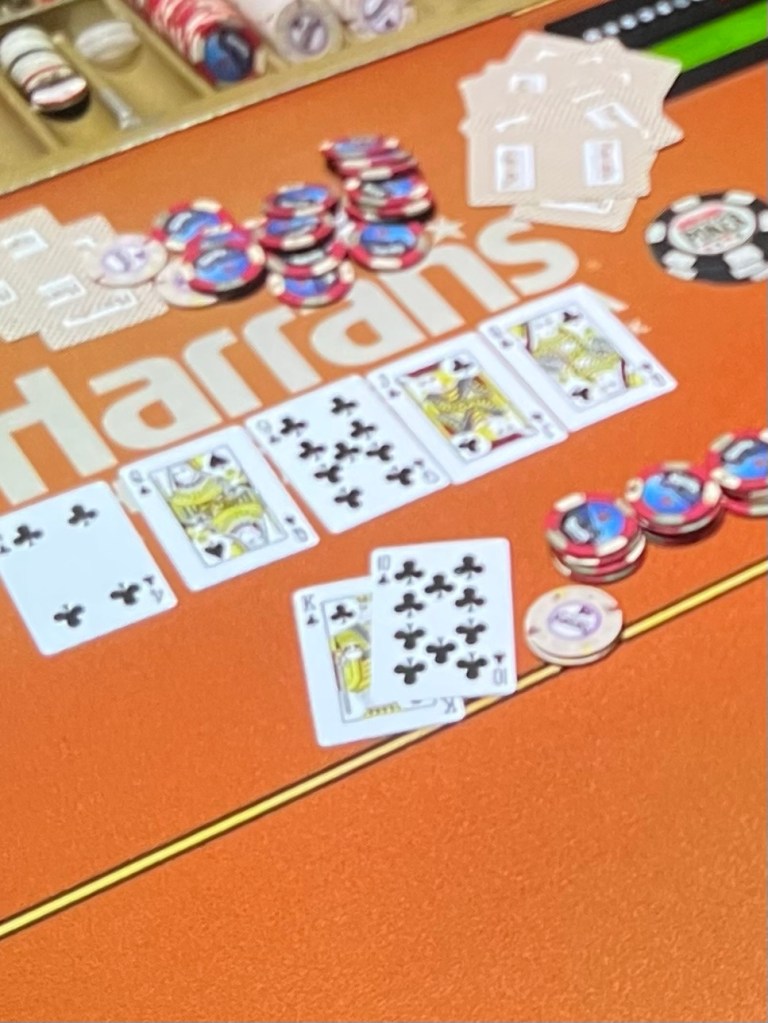
🃏 Ultimate Texas Hold’em Basics: How to Play, When to Bet, and What New Players Must Know
Ultimate Texas Hold’em (UTH) is one of the most popular casino poker games because it blends the strategy of Texas Hold’em with the simplicity of playing head‑to‑head against the dealer. If you’re searching for a beginner‑friendly guide that explains the rules, betting structure, and basic strategy, this article breaks everything down in a clear, SEO‑optimized format.
⭐ What Is Ultimate Texas Hold’em?
Ultimate Texas Hold’em is a house‑banked poker game where players compete directly against the dealer using standard Texas Hold’em hand rankings. Unlike traditional poker, you’re not bluffing opponents — you’re making strategic decisions about when to raise, when to check, and when to fold.
🎯 How Ultimate Texas Hold’em Works (Step‑by‑Step)
- Place Your Bets
To start a hand, you must place:
- Ante
- Blind
Optional:
- Trips bet (pays based on your final hand strength)
- Receive Your Two Cards
This is where the most important decision happens. You can:
- Check, or
- Raise 3x–4x your Ante
This early raise is the strongest move in the game.
- The Flop
Three community cards are revealed. If you didn’t raise earlier:
- You may check, or
- Raise 2x your Ante
- Turn & River
Two more cards are dealt. If you still haven’t raised:
- You may raise 1x, or
- Fold
- Dealer Qualification
The dealer must have at least a pair to qualify.
If not, your Ante pushes, but your Play and Blind bets still resolve normally.
💰 How Payouts Work in Ultimate Texas Hold’em
Play Bet
- Paid 1:1 if your hand beats the dealer.
Ante Bet
- Paid 1:1 only if the dealer qualifies.
Blind Bet
- Pays based on a payout table for strong hands (straight or better).
- Pushes on weaker winning hands.
Trips Bet
- Pays based solely on your final hand, regardless of whether you beat the dealer.
📘 Beginner Strategy for Ultimate Texas Hold’em
If you want to lower the house edge and play correctly, follow these simple strategy rules.
Pre‑Flop: Raise 3x–4x With Strong Hands
Raise early with:
- Any pair
- Any Ace
- Kx suited
- Q8+
- J10, J9 suited
- Most suited connectors
This is the most profitable decision point in the game.
Flop: Raise 2x When You Connect
Raise if you have:
- Top pair or better
- Strong draws (open‑ender, flush draw with overcards)
- Any pair that likely beats the dealer
River: Raise 1x or Fold
Raise if:
- You have at least a pair
- You have Ace‑high that beats many dealer hands
Fold if:
- You have nothing and the board is dangerous (paired, straight, or flush heavy)
🎲 Why Ultimate Texas Hold’em Is Great for Beginners
- Easy to learn
- Low house edge with correct strategy
- Fast gameplay
- Big decisions without complex opponent reading
If you enjoy poker but want a casino game with real strategic depth, Ultimate Texas Hold’em is one of the best options on the floor.
If you enjoyed this article please like, share, comment, subscribe. See you at the tables!
Poker Position 101
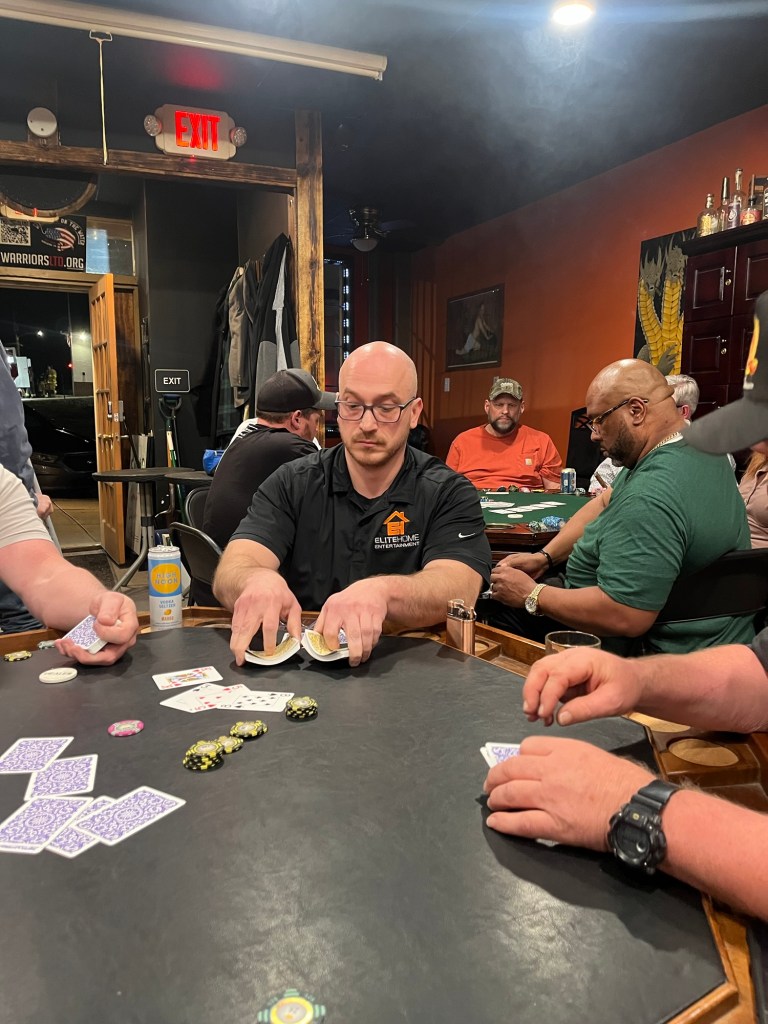
I wrote an article recently called the importance of understanding position in poker and have had several people ask me more about the different positions and what they are called. I decided to follow up with this simple explanation as a back to basics.
Poker table positions are one of the most important concepts for beginners to learn in Texas Hold’em (the most popular poker variant). Your position at the table determines when you act in each betting round, which gives you more (or less) information about what other players are doing. Acting later is a huge advantage because you see everyone’s actions before deciding.
The dealer button (a small disc labeled “Dealer”) moves clockwise each hand, so positions rotate. This guide focuses on a standard 9-handed (full-ring) table, common in live games and many online settings.
Why Position Matters for Beginners
• Early positions act first → tougher, play fewer hands.
• Late positions act last → easier, play more hands aggressively.
• Blinds post forced bets but act out of order.
Positions are grouped into early, middle, late, and blinds.
Poker Positions Explained (9-Handed Table)
1. Small Blind (SB)
Directly left of the button. Posts the small forced bet (half the big blind). Acts second-to-last preflop (after big blind calls/raises) but first postflop (after the flop). Tricky spot—play carefully.
2. Big Blind (BB)
Left of the small blind. Posts the full forced bet. Acts last preflop (great for seeing raises) but second postflop. Defend your blind with decent hands.
3. Under the Gun (UTG)
First to act preflop (left of big blind). “Under the gun” means pressure—no one has acted yet. Tightest position—only play strong hands.
4. Under the Gun +1 (UTG+1)
Next after UTG. Still early position. Similar to UTG: be selective.
5. Lojack (LJ) or Middle Position
Early-middle. More flexibility than UTG but still somewhat early.
6. Hijack (HJ)
Middle-late position (right of lojack). Good spot to open-raise if folded to you.
7. Cutoff (CO)
Right of the hijack (one seat right of button). Strong late position—often steal blinds with wider ranges.
8. Button (BTN)
The dealer position (button in front). Best seat overall. Acts last postflop in almost every hand—maximum information. Play most hands aggressively here.
Quick Tips for Beginners
• Position > Cards — A mediocre hand in late position often beats a good hand in early position.
• Always note the button location—it shows who’s in late position.
• In online poker or 6-max games, positions shift (fewer early seats, more late-play opportunities).
• Start by playing tight from early positions and looser from late.
Mastering positions will instantly improve your game more than memorizing hand rankings. Practice at low-stakes tables, watch where the button is, and ask yourself: “Do I act early or late?” Good luck at the tables
If you enjoyed this article please like, comment subscribe and share. Thank you and see you at the tables!
Monthly Home Game March
Another good time, cigars, beverages, and cards! 18 players battling for 1st place prize and points to the championship! Action was slow till level 2 brought tons of action! After the break players returned to 150/300 blinds and things really heated up! Action quickly progressed from 3 starting tables to 2 and now down to 1.
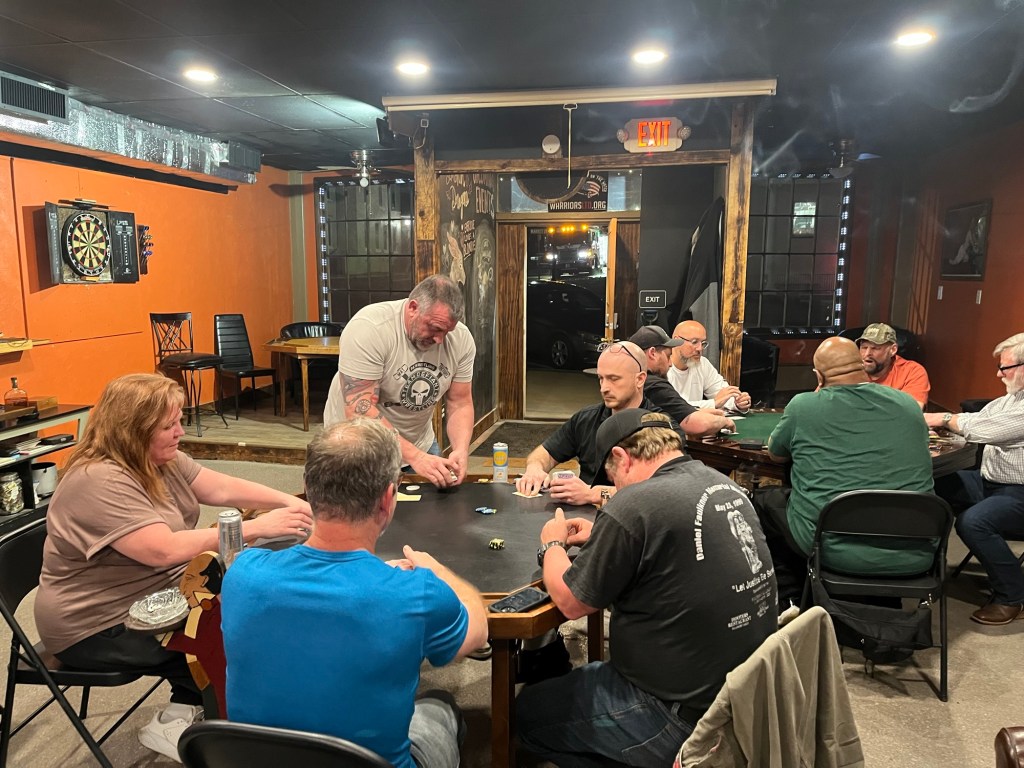
Final table action takes off at 350/700…and we’re off!
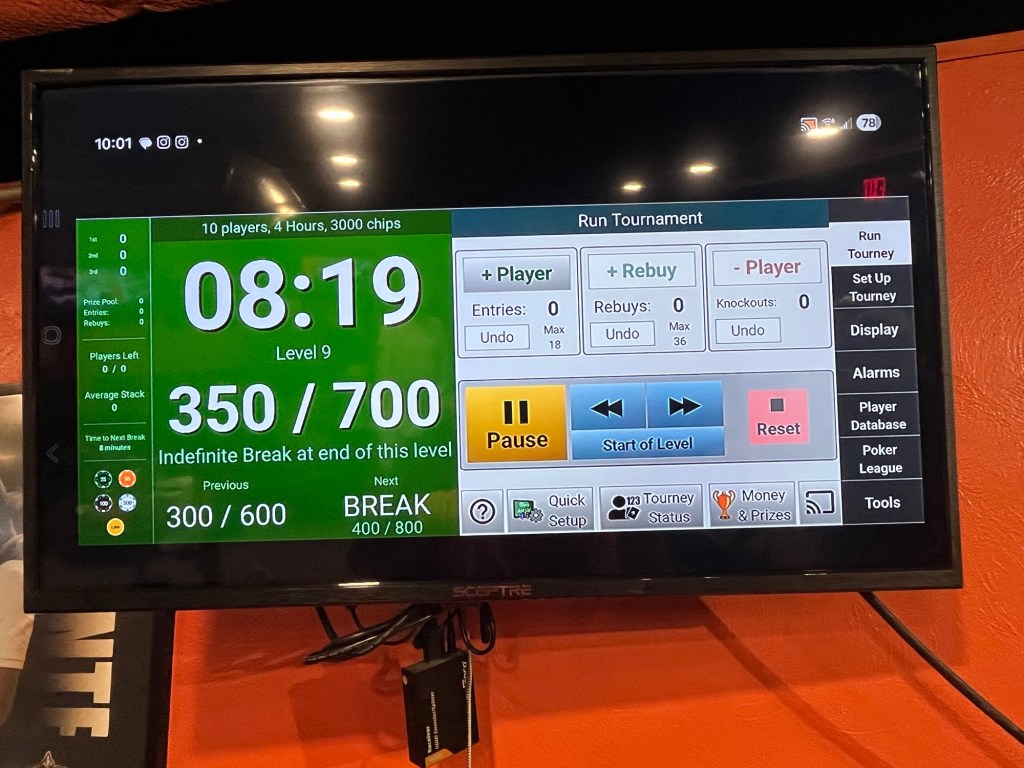

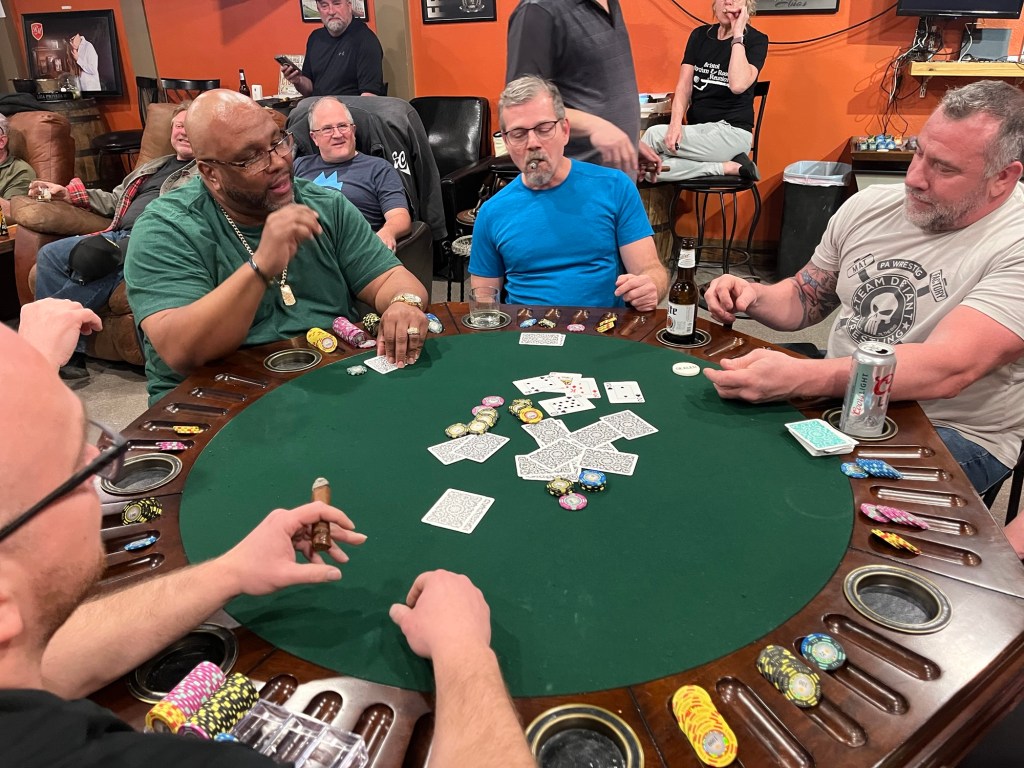
Action continues fast and furious till we get to the final 4. But then Leslie loses to quad 4s to Lem who also now takes the high hand. Play now down to 3.
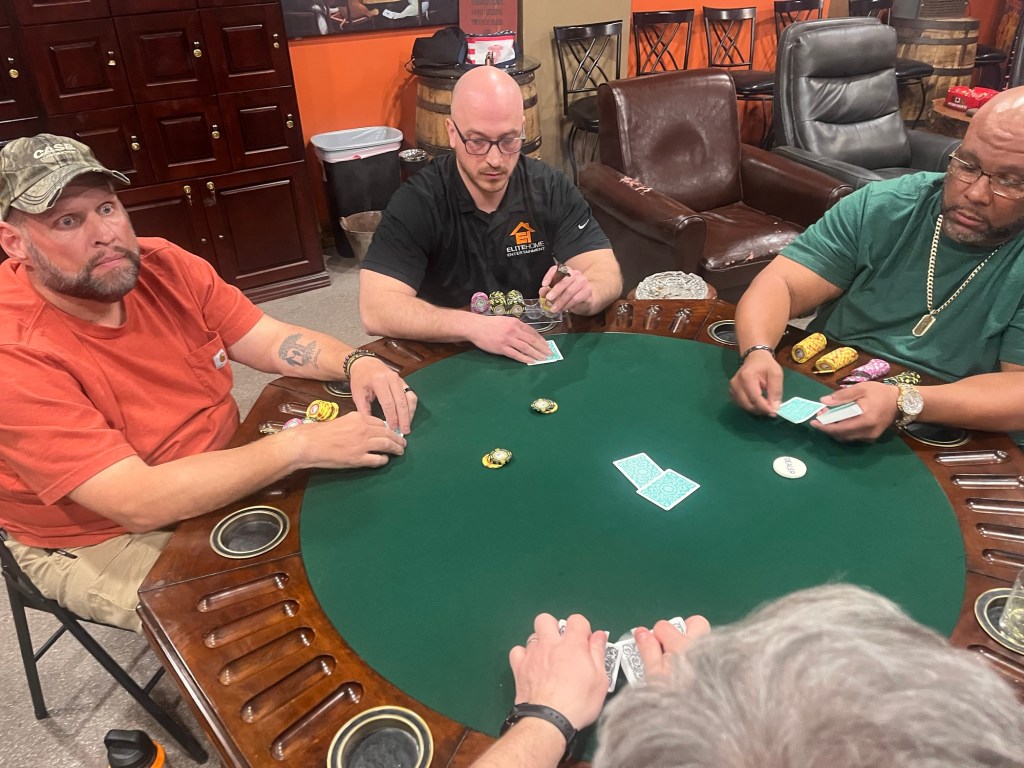
After some back and forth Jeff wins a much needed hand with Pocket Aces, however a few hands later the game end in a wild hand!
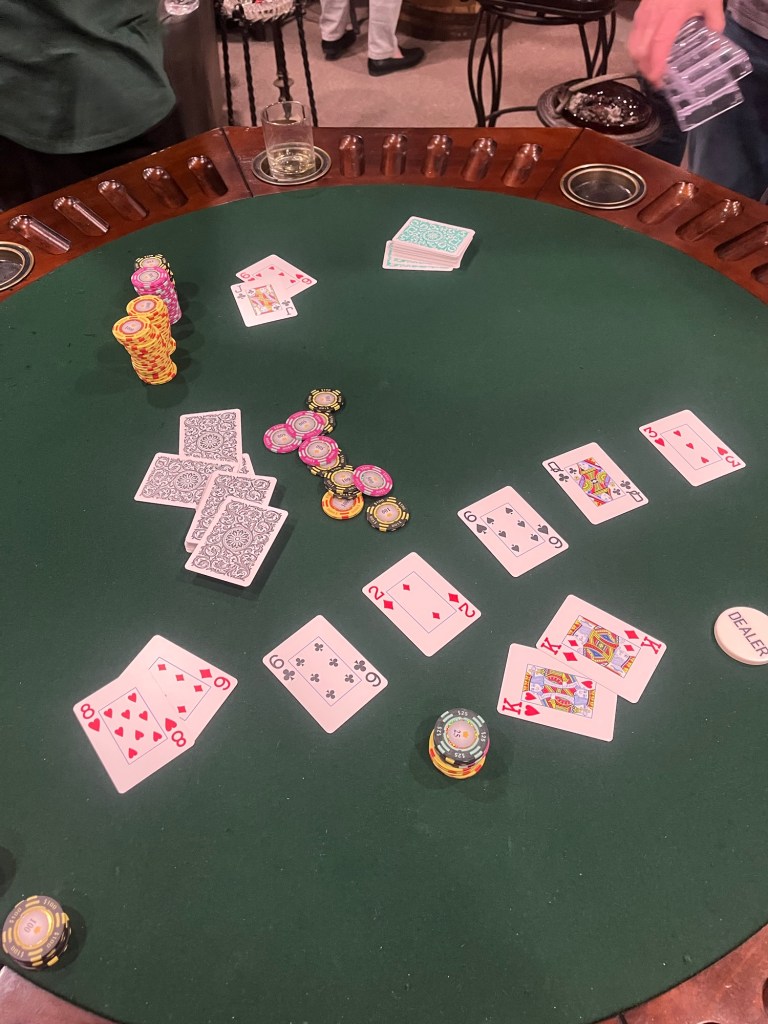
Jeff flat calls with King King, Terry and Lem are in the blinds, Terry calls from the small 8 6 off and Lem checks his option with K 6 off. Flop comes out 6 3 6. Jeff jams all in with 2 pair, Terry and Lem both call with Trips… Lem is the winner when his his King kicker holds.
Congratulations to all 3 and Leslie and Sean both earn points toward the Championship.
Implied odds in poker. What the heck are they?
What Are Implied Odds in Poker? A Complete Guide for 2026 Players
If you’re serious about improving your Texas Hold’em game—whether in cash games, tournaments, or online poker—you’ve probably heard the term implied odds. Many players understand pot odds, but implied odds often separate winning players from break-even ones.
In this guide, we’ll break down exactly what implied odds are, how they differ from pot odds, when they matter most, real-world examples, and practical tips to use them at the table. By the end, you’ll know precisely when to call with draws that look “unprofitable” on paper.
What Are Implied Odds in Poker?
Implied odds refer to the additional money you expect to win on future betting streets if you complete your drawing hand.
Unlike pot odds (which only look at the current pot and the price to call right now), implied odds factor in future bets your opponent(s) will likely pay once you hit your hand.
In short:
• Pot odds = What the pot offers now
• Implied odds = What the pot will likely offer later if you improve
This concept shines in no-limit Hold’em (especially deep-stacked cash games), where players can win big pots after hitting strong hands like straights, flushes, or sets.
Pot Odds vs Implied Odds: Key Differences
Pot odds tell you if a call is +EV based on current math. Implied odds let you justify calls when pot odds alone aren’t enough—because you expect to stack your opponent (or win big) when you hit.
How to Calculate Implied Odds (Simple Formula)

There’s no perfect formula since it involves estimation, but here’s a practical way pros think about it:
1. Calculate your pot odds first.
2. Figure out how much equity you need (your “required equity”).
3. Estimate how much extra money you’ll win if you hit.
4. Add that to the current pot → get your effective implied pot.
Basic shortcut (great for quick decisions):
Required extra $$ on later streets = (Amount to call × Required odds) – Current pot after call
Example (common flush draw on the flop):
• Pot = $100
• Opponent bets $50 → Pot now $150
• You must call $50
• Pot odds = 150:50 = 3:1 (you need ~25% equity to call)
• Flush draw has ~35% equity to hit by river (9 outs × 4 ≈ 36%)
• Pot odds alone say call is profitable
But suppose pot odds were worse (e.g., opponent bets $200 into $100 pot → you need to call $200 for $300 pot = 1.5:1, need ~40% equity).
• Your flush draw is only ~35% → looks like a fold.
• But if stacks are deep and villain pays off big when you hit → you add implied money.
If you estimate villain will pay $400 more on turn + river when you hit → your effective pot becomes $300 + $400 = $700.
New implied odds = 700:200 = 3.5:1 → now a profitable call.
Real Poker Example: Flush Draw with Great Implied Odds
Scenario (No-Limit Hold’em, 200bb deep stacks):
• You have A♠ K♠ in the big blind.
• Flop: 9♠ 7♠ 2♦ (you have the nut flush draw + overcards)
• Pot = $60
• Villain (loose-aggressive fish) bets $45
• You call $45 (pot now $150)
Turn brings 4♥ (still draw)
• Villain bets $120
• Pot = $270
• You need to call $120
Raw pot odds = 270:120 ≈ 2.25:1 → need ~31% equity.
Your equity to hit flush on river = 9 outs / 46 cards ≈ 19.6%
Looks bad… but implied odds save the day.
Villain has shown he overvalues top pair and will stack off with it. Effective stacks behind = $400.
If you hit your flush, you expect to win at least $300–$400 more (villain calls your river shove or bets big).
Effective pot if hit ≈ $270 (current after call) + $350 (expected) = $620+
Implied odds ≈ 620:120 ≈ 5:1 → way better than needed.
You call profitably, even though raw pot odds + equity say no.
Reverse example (bad implied odds): Short-stack opponent or tight player who folds to river bets → implied odds near zero → fold the draw.
When Implied Odds Are Highest (and Lowest)
Great implied odds situations:
• Deep stacks (150bb+)
• Draws to nuts (nut flush, straight)
• Loose/passive opponents who pay off big
• Multiway pots (more people to pay you off)
• You have disguised strength (e.g., set-mining with small pairs)
Poor implied odds situations:
• Shallow stacks (<50bb)
• Non-nut draws (weak flush, gutshot)
• Tight/aggressive opponents who fold to aggression
• Board is scary/paired (opponent fears worse)
• You’re out of position
Common Mistakes Players Make with Implied Odds
1. Overestimating how much they’ll win → “He’ll pay my whole stack!” (Reality: villain often checks back or folds.)
2. Ignoring reverse implied odds → You hit, but villain has a better hand and stacks you.
3. Calling too much on turn → Turn calls need higher implied odds since only one street left.
4. Using implied odds to justify every draw → Sometimes pot odds alone are terrible and future money won’t compensate.
Final Tips to Master Implied Odds
• Ask yourself: “If I hit, how much will this specific opponent pay me?”
• Adjust for villain type (fish = high implied, reg = lower).
• In tournaments, implied odds drop as stacks get shorter.
• Practice with tools like equity calculators to compare raw vs. implied scenarios.
• Remember: Implied odds are an estimate—lean conservative until you know your opponents well.
Mastering implied odds turns marginal calls into big winners and helps you avoid expensive mistakes. Next time you’re facing a draw with “bad” pot odds, pause and calculate the implied potential—it might be the most profitable play at the table.
What are your biggest implied odds leaks? Drop a comment below—I read them all!
Ready to level up your poker math? Check out our guides on pot odds, equity realization, and reverse implied odds.
If you enjoyed this article please like, share, comment and subscribe! Thanks and I’ll see you at the tables!
Home Game Tournament Blind Timer
Here’s a quick blog post about the benefits of using a Blind Timer in your home games. Below is a great low priced option that you can order with the link below. Great way to bring a professional touch to your home game!
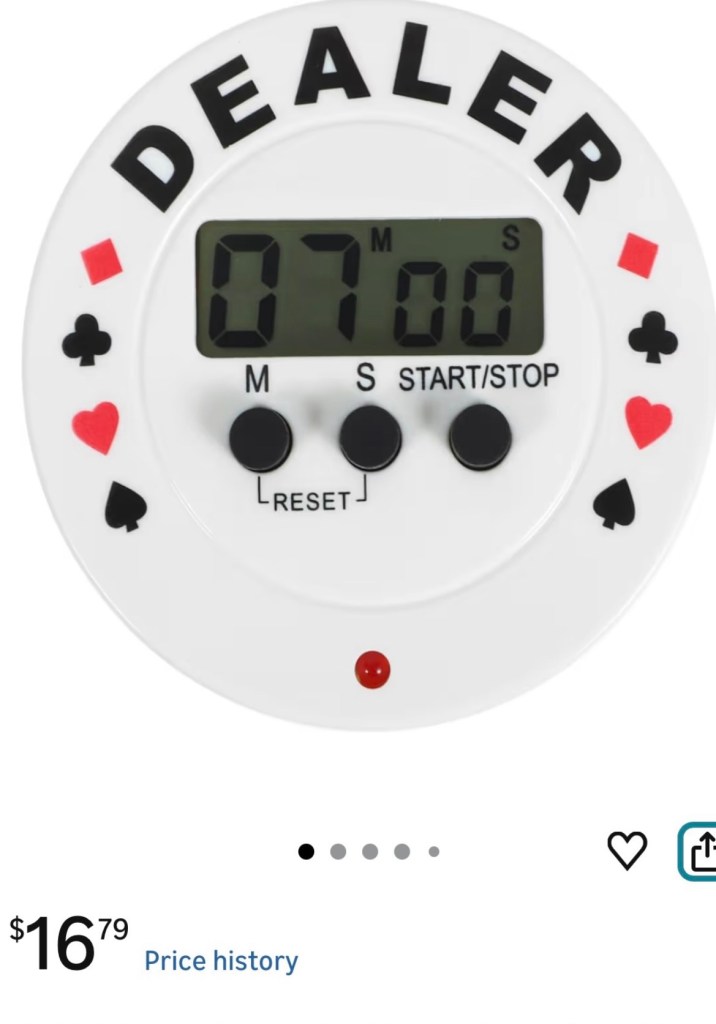
Why Every Home Poker Game Needs a Timer (And How to Use One)
If you’ve ever hosted (or played in) a home poker night, you know the drill: blinds creep up slowly because someone forgets to call “blinds up,” the game drags on forever, players get tired or bored, and suddenly it’s 2 a.m. with half the table still in but everyone wanting to go home. Enter the humble poker timer—one of the simplest upgrades that makes your home games feel way more professional and enjoyable.
A poker timer (usually a free or cheap app on your phone/tablet) handles blind levels, breaks, and alerts automatically. No more awkward “hey, can we speed this up?” moments.
Key Benefits of Using a Timer
• Keeps the game moving at a predictable pace — Everyone knows exactly when blinds increase, so play stays action-oriented instead of turning into a 6-hour slog.
• Prevents arguments over timing — “Did the level just end?” disappears when a loud beep or voice announces “Blinds up!” and shows the new levels.
• Creates better poker — With structured blind increases, short stacks get pushed, decisions matter more, and skill (not just chip hoarding) shines through.
• Builds in breaks — Most timers let you schedule 5–10 minute pauses for snacks, bathroom runs, or a quick stretch—keeping energy high.
• Ends games on time — Want a 3–4 hour tournament? Set it up so the structure finishes around then instead of dragging indefinitely.
A lesson in playing $2/$5 min buy.
Since recently I got a chance to play $2/$5 and got stacked, I decided to do my research and write an article about how to best play with a minimal buy in. I included the resources.

Optimal Starting Hands for $2/$5 Poker: Short Stack Strategy with Minimum Buy-In (40BB)
If you’re grinding $2/$5 No-Limit Hold’em live cash games and buying in for the minimum (usually $200, or 40 big blinds), your poker strategy must change dramatically from the deep-stack playbook most players follow.
With only 40BB, you can’t rely on implied odds, multi-street bluffs, or speculative hands like suited connectors. Instead, you need tight, aggressive preflop play focused on premium starting hands that make strong top pairs or better right away.
In this guide, we’ll break down the optimal starting hands for $2/$5 poker at minimum buy-in, provide position-based ranges, and share pro tips to maximize your edge. Whether you’re new to short-stack play or looking to optimize your $2/5 NLHE strategy, this is your complete roadmap.
Why Minimum Buy-In Changes Everything in $2/$5 NLHE
Most $2/$5 tables allow a minimum buy-in of $200 (exactly 40 big blinds). This short-to-mid stack depth turns the game into a high-variance, preflop-heavy battle.
Key differences from 100BB+ deep stacks:
• No set-mining with small pairs (implied odds disappear).
• Fewer postflop decisions — you often raise-or-shove preflop or commit on the flop.
• You play for stacks quickly, so hand strength and fold equity matter most.
• Opponents (recreational players and regs) overcall lighter, giving your premiums massive value.
Short-stacking isn’t always optimal long-term (deeper stacks let you extract more value), but it’s bankroll-friendly for $2/$5 and exploits loose tables common at this stake.
Optimal Starting Hands by Stack Depth (40BB Focus)
At exactly 40 big blinds, prioritize big-card strength hands that flop top pair or better. Avoid suited connectors (87s, T9s), small pocket pairs (22-55), and weak aces (A5s-A2s) — they lose money without deep implied odds.
Core 40BB Starting Hand List (from strongest to playable):
• Premium pairs: AA, KK, QQ, JJ
• Strong aces: AKs, AQs, AKo, AQo, AJs
• Borderline: TT, AJo, KQs (add selectively by position)
As your stack drops toward 30BB or below, tighten further and shift to shove-or-fold.
Quick Reference by Effective Stack:
• 40BB: AA–JJ, AKs–AQs, AKo–AQo, AJs
• 30BB or less: Add AJ, TT, ATs, KQs
• 20BB or less: Add AT, KQ, KJs, KJ
• 10BB or less: Push any Ax, QJs, QJ (all-in preflop)
These hands dominate because they win at showdown often and play well when you jam.
Position-Based Opening Ranges for $2/$5 Short Stack (40BB)
Position still matters — even short-stacked. Here’s a simple, profitable range structure for a typical 9-handed $2/$5 table:
Early Position (UTG, UTG+1):
Play ultra-tight (top ~8-10% of hands).
Raise 3–4x BB (or larger to $20–$25).
Hands: AA–JJ, AKs–AQs, AKo–AQo
Middle Position (MP):
Slightly wider.
Hands: AA–TT, AKs–AJs, AKo–AJo, KQs
Late Position (Cutoff, Button):
Steal more aggressively, especially vs. passive blinds.
Hands: AA–99, AKs–ATs, AKo–AJo, KQs–KJs, QJs
(Shove wider from Button if blinds fold often.)
Blinds Defense:
3-bet shove premiums vs. opens. Call lighter only with position and very weak openers.
Pro Tip: Always raise first-in — never limp. At $2/$5, a $15–$20 open builds the pot while giving you fold equity. If facing a raise, 3-bet shove your strongest hands (QQ+, AK) for maximum pressure.
How to Play These Hands Postflop (Short Stack Style)
With 40BB, postflop play is simple ABC poker:
• Hit the flop strong? Bet big or jam (especially top pair top kicker or better).
• Miss? Check-fold unless you have a strong draw with equity.
• C-bet size: 50–75% pot or all-in on coordinated boards.
• Avoid fancy bluffs — your edge comes from value, not hero folds.
Example: You open AKs from middle position for $20. Flop comes A-7-2 rainbow. With ~35BB behind, jam — most $2/$5 opponents call with weaker aces or draws.
7 Essential Tips for Winning $2/$5 Short Stack Play
1. Learn preflop ranges cold — Every decision is worth big chunks of your stack.
2. Track effective stacks — Always play to the shortest stack at the table.
3. Raise bigger preflop — $15–$25 opens deter multi-way pots.
4. Exploit loose callers — $2/$5 players love calling with KJo or 76s — your premiums crush them.
5. Don’t get below 30BB — Top up if you lose a pot to stay in the 40BB sweet spot.
6. Leave after doubling up (optional) — Many short-stackers cash out winners to lock in profit.
7. Bankroll for variance — Short-stack play has big swings; bring 30–50+ buy-ins.
Common Mistakes to Avoid in $2/$5 Minimum Buy-In Games
• Playing suited connectors or small pairs — They bleed money without implied odds.
• Limping or min-raising — Builds small pots and invites multi-way action.
• Being too passive — Short stacks must apply pressure.
• Ignoring table dynamics — Looser tables = wider late-position steals.
Final Thoughts: Crush $2/$5 with Minimum Buy-In
Mastering these optimal starting hands for $2/$5 poker with a 40BB minimum buy-in gives you a massive edge over recreational players who treat it like deep-stack poker. Stick to premiums, play tight-aggressive, and watch your win rate climb.
If you enjoyed this article please like, comment, share or subscribe! Thank you and I’ll see you at the tables!
Article Sources:
Early Stage play in a multi table Poker Tournament
Mastering Early-Stage MTT Play: Play Tight, Stick to Premium Hands, and Exploit Weakness Like a Pro
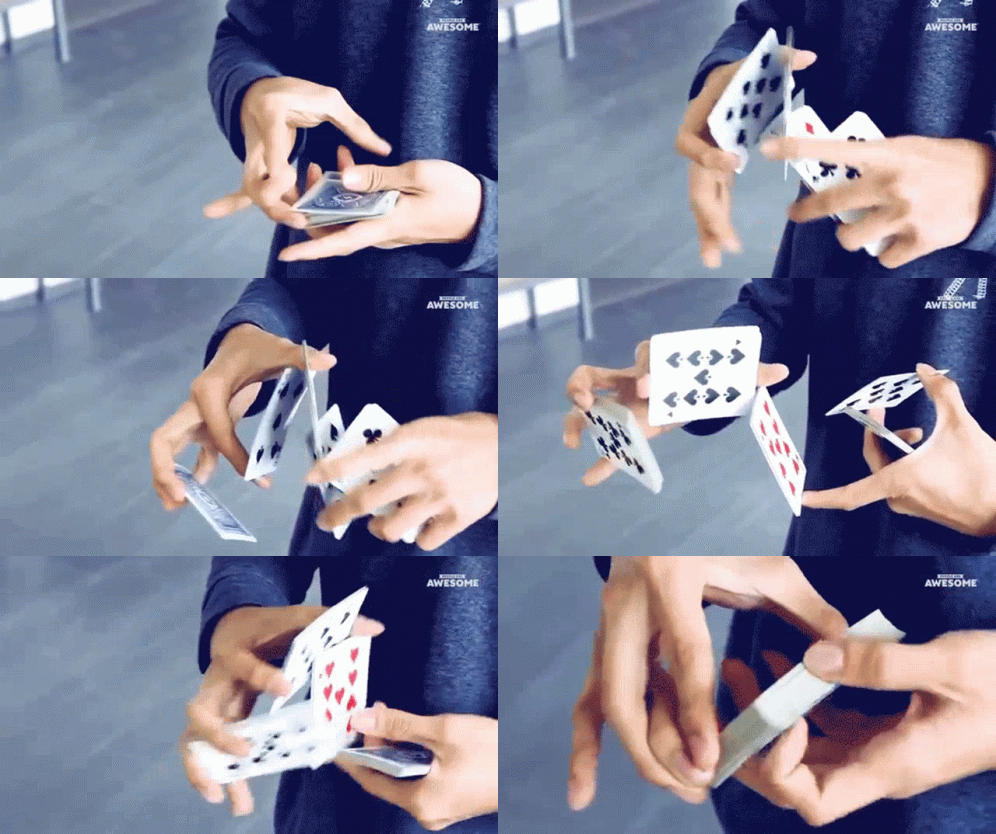
If you’ve ever busted out of a poker MTT in the first two hours with a speculative suited connector or a marginal ace, you know the pain. The blinds are tiny, the stacks are deep (usually 100+ big blinds), and there are still hundreds of players left. Yet so many amateurs treat the early stages like a cash game and spew chips left and right.
The truth? Playing tight early is one of the highest-EV adjustments you can make in modern MTTs. It’s not “nitty” — it’s disciplined. You’re not there to gamble; you’re there to survive, accumulate, and exploit the recreational players who are dying to give you their chips.
Here’s exactly how to do it — from hand selection to exploitation tactics that print money when everyone else is playing loose.
Why Tight Is Right in the First 2–4 Levels
- Stack preservation is king. With 100–200bb effective stacks and tiny blinds (0.5–1bb per orbit), you don’t need to steal blinds to stay alive. One bad flip or cooler can cripple you for the entire tournament.
- ICM hasn’t kicked in yet. You’re not fighting for pay jumps — you’re fighting for chip EV. Premium hands realize their equity best against multiple callers and deep stacks.
- The field is at its weakest. Recreational players are still in “fun mode.” They limp, call 3-bets with KJo, and pay off top pair with second pair. Your job is to be the shark in the tank.
Tight play early isn’t passive — it’s selective aggression. You play fewer hands, but you play them for maximum value.
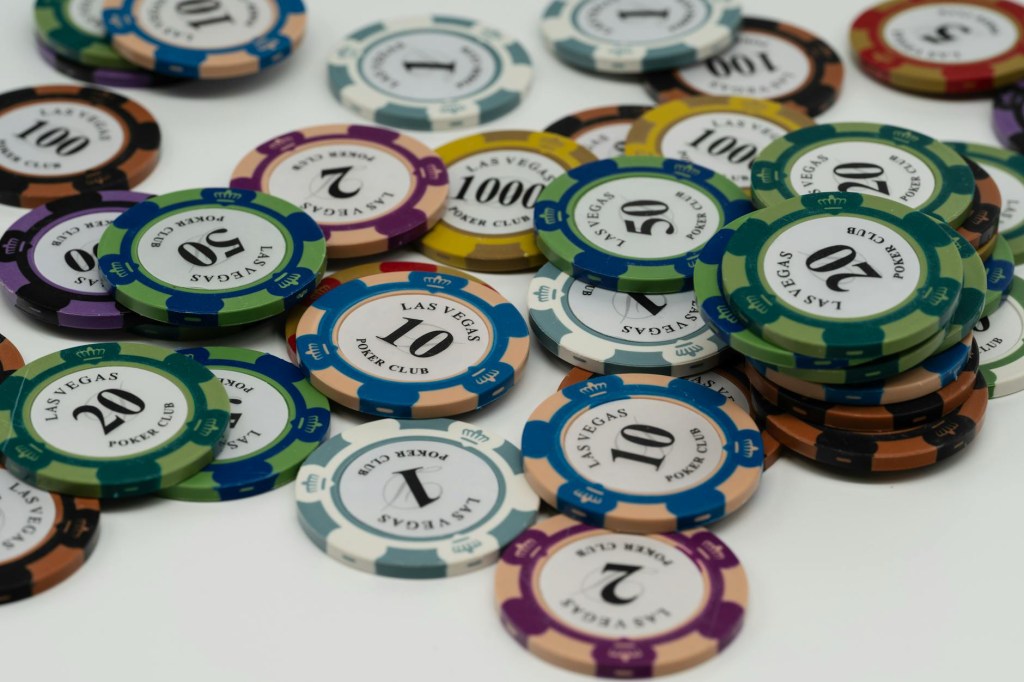
The Early-Stage Opening Range: Only the Top ~8–10% of Hands
Forget the 25% “standard” cash-game range. In an MTT with 100+bb stacks and 9-handed tables, your default opening range should look something like this (adjust slightly by position):
Early Position (UTG, UTG+1)
AA–TT, AKs–AQs, AKo–AQo, KQs
Middle Position
Add: 99–88, AJo, KJs, QJs, JTs
Late Position (Cutoff, Button)
Add: 77–66, ATo–A9s, KQo, suited connectors down to 98s (only if you have a solid postflop edge)
Big Blind Defense
Call or 3-bet only with the above plus occasional suited broadways and pocket pairs when the price is right.
Pro Tip: If the table is super soft (multiple limpers every orbit), you can widen your late-position range slightly — but never open 22 or 76s from early position just because “it’s cheap.”
How to Play Your Premium Hands for Maximum Value
- AA–KK: Raise big, always.
3–4x in early position, 2.5–3x late. If there are limpers, iso-raise huge (5–7x + 1x per limper). You want to isolate the weak players and build the pot immediately. - QQ–JJ & AK: Your bread-and-butter.
Raise standard sizing. 3-bet AK every time vs opens (especially from loose openers). With QQ–JJ, mix in flat-calls vs tight opens but 3-bet aggressively vs loose players. - Premium suited aces (AQs–AJs) and KQs:
These are your money-makers against weak ranges. Raise, call 3-bets in position, and be ready to stack off on ace-high flops when villain shows weakness. - Pocket pairs 88–TT:
Set-mine only if you’re closing the action or getting great implied odds (multiple callers behind). Otherwise, raise and take it down preflop.
Golden Rule: Never limp. Never flat-call raises with these hands unless you’re trapping a maniac (and even then, 3-bet most of the time).
Exploiting Weakness: The Real Money-Maker

This is where tight players separate themselves from the pack. While you’re waiting for premium hands, you’re laser-focused on the table dynamics.
Target these player types early:
- The “Fun Guy” — Limps 40% of hands, calls 3-bets with any two broadways, and never folds top pair.
- The Sticky Fish — Calls every raise with suited connectors and small pairs, then pays off when he hits second pair.
- The Over-Limper — Limps every orbit from every position. These players are printing money for you.
Exploitation Tactics:
- Iso-raise relentlessly. Limpers + one raise = your premium hand gets called by junk. A 5–7x iso-raise with AK or QQ often wins the pot preflop or gets heads-up against a dominated hand.
- 3-bet light vs weak openers. If a loose early-position player opens 25%+, 3-bet AK, AQ, and even some bluffs (but mostly value). They fold too much and call too wide when they do continue.
- Barrel weakness. On A-high or K-high boards, these players will check-fold second pair or gutshots way too often. One or two continuation bets usually take it down.
- Value bet thin. They call down with Kx on an A-high board. Bet your top pair for three streets.
Example Hand (real-life spot I’ve seen 100 times):
Hero (Button, 150bb): AKo
Villain (MP, recreational, limped 6 of last 8 orbits): Limps
Hero raises 5x. Villain calls.
Flop: A♠7♥3♦
Villain checks. Hero bets 60% pot. Villain calls.
Turn: 9♣
Villain checks. Hero bets 70% pot. Villain calls.
River: 2♠
Villain checks. Hero bets 80% pot and gets called by K7o.
That’s +150bb because you played tight early and waited for the right spot to isolate weakness.
Common Mistakes to Avoid
- Opening too wide early just because “the blinds are small” — variance will destroy you.
- Getting married to suited connectors preflop — save them for middle/late stages when stacks are shallower.
- Failing to adjust when the table tightens up — if everyone is suddenly playing solid, widen slightly in position.
- Slow-playing monsters — build the pot early against weak players who over-call.
Final Thoughts: Tight Early = Stack Monster Later
Playing tight early in an MTT isn’t boring — it’s strategic patience. You’re not folding to win; you’re folding to set up the biggest stack at your table when the blinds start to matter and the weak players start making massive mistakes.
Stick to the top hands, iso-raise the limpers, 3-bet the weak openers, and value bet relentlessly. Do this for the first 2–4 levels and you’ll find yourself at the final table with a massive stack far more often than the gamblers who “just wanted to see a flop.”
Now go crush those early stages.
What’s your biggest leak early in MTTs? Drop it in the comments — I read every one.
If you enjoyed this article please like, share, comment and subscribe! Thank you and I’ll see you at the tables!

Atlantic City Trip Day 2
Woke up and checked out of Cesars they were really great about us leaving early and going to a different casino.
We decided to drive to Margate and see Lucy the elephant, I was told about this from a friend,which was really cool. I have to admit though I thought it was going to be a real elephant, I was wrong but still really great site to see.

Driving to Tropicana we saw a fire truck headed to the hotel but honestly thought nothing of it. We are in line at the front desk when a young man says I just came down to get a new room , um mines flooded from the sprinklers going off due to a fire or something, I’m not sure because I’m still hung over. My wife quickly asked what tower because I hope we’re not staying there! The young man was super cool and it appears he and the other guests involved will be well taken care of!
My wife and I go to check in and in my haste last night to find a different room accidentally booked March 19 by mistake. Host was super amazing and quickly sorted it out and we were booked in minutes.

Finally had a chance to play cards so I bought in min for $2/$5 well $600, I was looking for good action but not a call fest. I played for a few hours up down couldn’t make anything work, eventually lost when I rammed 77 into a caller on a straight and a flush draw, I had hit a set on the flop. I shoved my stack and got called for a river straight. The pot was already $70 plus preflop so I figured my set was good…
Overall nice poker room, fun, mixed batch of players, good pace and well run!
Anyway spent the rest of the night hanging out with my wife, great few days so I’ll call it a win!

If you liked this article please like, share or subscribe. Thank you and I’ll see you at the tables!

Atlantic City trip Day 1
So over the past week won a Super Bowl block for $175 then managed to spin that up to $1000. Playing cards between Perryville poker room and a Championship tournament in my local home game. Decided to get out of town with my wife for a couple days to Atlantic City.

We normally stay at Harrahs because we are always treated great there, practically locals in our favorite Poker bar “ the exhibition bar”. However my wife wanted a change of pace so we booked Cesars for 2 nights…
First off it’s a Wednesday so maybe that’s part of it, but no poker room was definitely a miss. Even the poker room at Ballys next door would have been okay but that’s gone too? Shame on me for not doing my research however the website says poker but it’s now only the dealer table game version Ultimate Texas holdem.
Poker Bar was great instantly served drinks while you play didn’t have to wait for the “ green light” and the bartender was amazing. played on the machines there and then I headed to the tables. Played Ultimate Texas Holdem and ended up +$200. My wife text me she was hungry it was 600pm so ok let’s eat however the only place open was Ramsays Pub? Don’t get me wrong I love Gordon, my brother has even met him, but the only restaurant I’ve ever had a complaint about in AC is the only place open in this huge casino at 600pm?
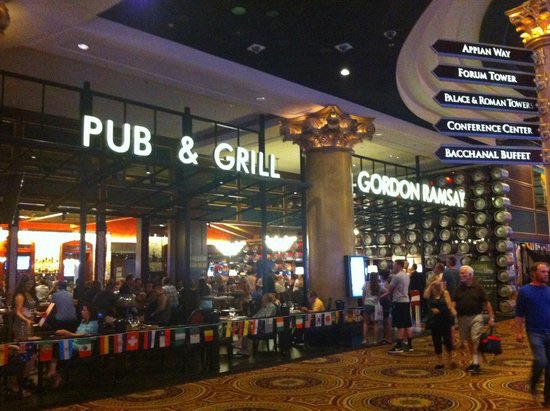

The meal was really good,my wife had a burger and I had fish and chips. Then went back to the tables tried to play Ultimate Texas Holdem again but the only table open was full. I played Top Flush, then 3 card poker both of which I hardly won more than 2 hands, lost $200 on each game! I did try to get even on craps but I should have just bet for 4 rollers to hit craps on 2 rolls each.
I decided to go back to the room and chill for a bit.. which really means lick my wounds. After talking to my wife for a bit we decided to change hotels so tomorrow we will be at Tropicana, nice room and more places to eat. My wife doesn’t really gamble so enjoying a nice dining experience is her jam!
We will see how it goes. Better food options and a poker room, so hopefully a better experience!
So for my poker followers, Cesars is not it! Great room just not the games that I was looking to play.
For Future reference the only poker rooms in AC are:
Borgata
Harrahs
Tropicana
If you enjoyed this article please like, share and subscribe. Thank you and see you at the tables!

Dominate the bubble in poker tournaments!
Detailed Bubble Stealing Tactics: Dominate the Poker Bubble in MTTs

The poker tournament bubble is a pressure cooker—one bust-out from the money, and play tightens dramatically. Bubble stealing tactics exploit this fear, letting you pillage blinds and antes from late position (CO/BTN) with massive fold equity. In MTTs, successful steals can double your stack without showdown, turning min-cashers into contenders. This guide delivers solver-backed poker bubble strategy, push/fold ranges, and exploits to crush it.
Why Bubble Stealing Crushes: ICM and Fold Equity
Near the bubble (e.g., 280/900 left), ICM makes busting devastating—bubble factor (survival value) spikes for shorts. Shorts fold premium hands; covers defend wider but still fold often. Antes (10-12.5%) amplify pots—win 2-3BB risk-free per steal.
Key Edges:
• Late Position: BTN sees 7 folds, ~50%+ success.
• Perceived Strength: Tight opens signal monsters.
• Exploits: Target play-to-cashers; spread aggression.
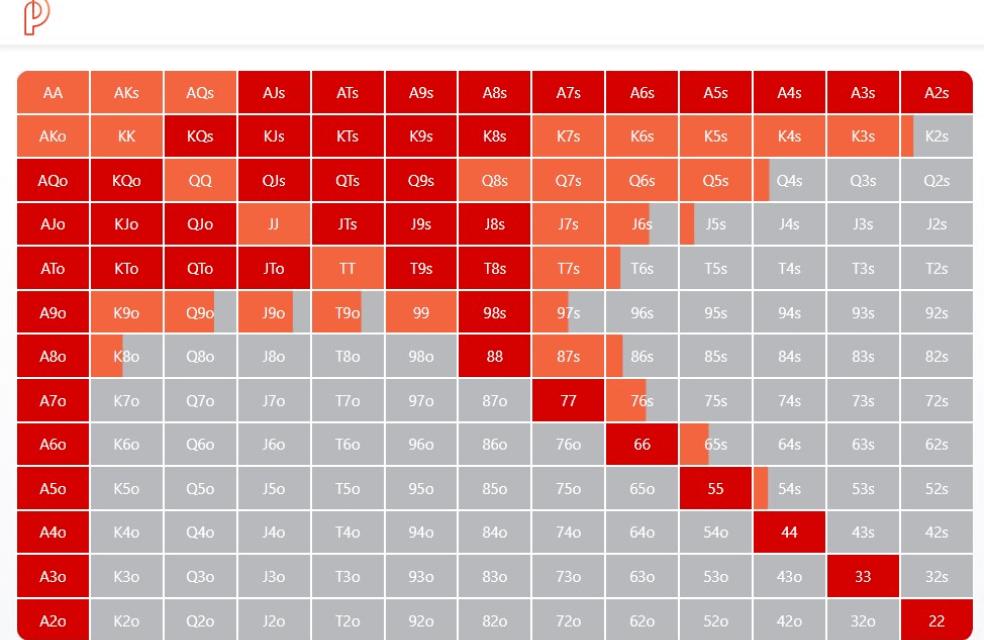
Preflop Bubble Stealing Ranges by Stack Size
Use min-raises (2-2.2x) over shoves for shorter stacks—preserves fold equity, builds pots. ICM tightens vs chipEV.
Short Stack (10-18BB): Push/Fold Heavy
• BTN: 38% (9% minraise + 29% shove @10BB); 39% @15BB. Heavy Ax/Kxs (blocks calls), pairs 22+, suited connectors 76s+
Medium Stack (20-40BB): Minraise + Selective Shoves
• BTN: 40-50% RFI. Mix value (QQ+, AK) with bluffs (A2s+, suited gappers).
• Shove over limps; 3-bet shove vs opens if blinds fold 70%+.
• Vs shorts in blinds: Wider, as they shove light.
Big Stack (50BB+): Wide Aggression
• BTN/CO: 50%+ RFI. Bully mediums/shorts—raise 2.5x, c-bet dry boards.
• Target: Weak blinds; avoid covers.
Sizing: 2x vs tights; 2.5-3x vs callers. Limpers ahead? Iso 4x+.
Key Factors for Bubble Steals
1. Opponent Stacks: Steal vs shorts (high ICM risk); tighter vs covers/BIGs.
2. Blinds’ Tendencies: HUD: Fold-to-steal >70%? Ramp up. Defenders? Tighten.
3. Table Image: Tight = steal wide; loose = value-heavy.
4. Bubble Pressure: 1-2 off? Max aggression. Post-bubble: Tighten.
5. ICM Tools: Use ICMizer/HRC for sims—bubble factor 2x+ warps ranges.
Re-Steals: BB 3-bet shove wide vs minraises if covering.
Post-Flop Tactics After Bubble Steals
Position = power. Simplify:
• Ace-High Flops (e.g., A62): Min c-bet 100% range—BB folds weak.
• Broadway (AQ2): Check medium (QJ, JJ) for equity; bet polar.
• Low Connected (854): Check back if unchecked; call donks wide.
• Barrel turns: Polar big bets on blanks.
Exploits: Vs passive BB, c-bet 70%; vs aggro, check/fold marginals.
Adjustments by Tournament Stage & Opponents
• Hard Bubble: Ultra-tight blinds—steal 4x/orbit from BTN.
• Soft Bubble: Wider defenses—focus value, fewer bluffs.
• Vs Weak: Late pos minraises every orbit.
• Short-Handed: Loosen 10-15% (fewer players).
10 Thinking Poker Tips:
1. Always raise (no limps).
2. Fold thin calls.
3. Target weak folders.
4. Size up aggro blinds.
5. Chat box reads.
6. Spread steals. 7-10: Defend smartly.
Common Mistakes to Avoid
• Static Ranges: Adjust per dynamics—don’t autopilot.
• Over-Shoving Deep: Minraise first.
• Ignoring ICM: Shorts fold more than chipEV.
• Predictability: Mix value/bluffs.
• Post-Bubble Tilt: Tighten immediately.
Real-World Example
Blinds 1k/2k +200 ante, you 18BB BTN vs tight BB (26BB). Folded to you: Minraise A5s (GTO). BB calls. Flop A62r: Min c-bet, BB folds. +3.2k chips. Repeat: Stack to 30BB pre-money.
Conclusion: Steal the Bubble, Cash Deeper
Master detailed bubble stealing tactics with ICM ranges, position, and exploits to ladder up. Practice in sims (GTO Wizard), review HUDs, and target leaks. From short-stack survival to big-stack tyranny, these moves print EV.
If you enjoyed this article please like, share, and subscribe! Thanks for reading and I’ll see you at the tables!

 THE PLAYER IN SEAT 4..
Recent Comments