$2/$5 NL Hold’em Bankroll Management: Protect Your Poker Money
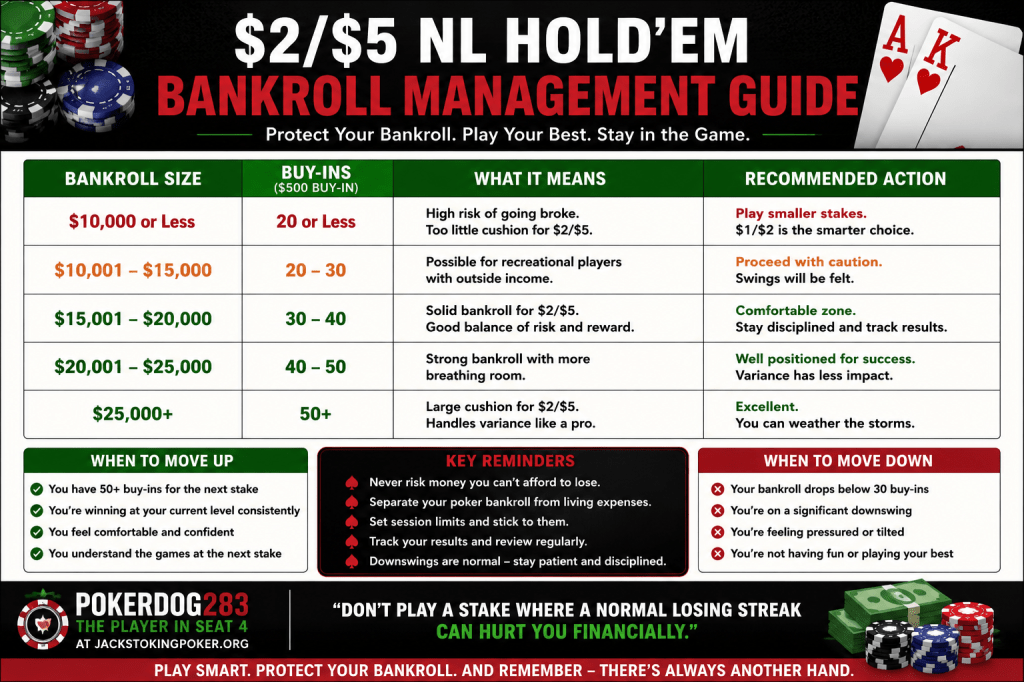
Playing $2/$5 No-Limit Texas Hold’em requires more than good cards and solid strategy—it requires proper bankroll management. Unlike $1/$2, the swings at $2/$5 can become significant very quickly. A $500 buy-in may disappear in one hand, and a few losing sessions can put a serious dent in your poker funds. As a general guideline, a regular $2/$5 player should consider having 30–50 buy-ins available. If you normally buy in for $500, that means roughly $15,000–$25,000 dedicated specifically to poker.
Your poker bankroll should be money you can afford to lose without affecting your everyday life. Don’t include rent, mortgage payments, emergency savings, or money needed for bills. It’s also important to separate your session bankroll from your overall bankroll. You might bring $1,000 or $1,500 to the table, but that doesn’t mean you only have that amount available for poker. Setting reasonable limits before you play can also help prevent chasing losses. If you’re down several buy-ins and find yourself playing emotionally rather than making good decisions, it’s probably time to step away.
One of the biggest bankroll mistakes is moving up in stakes too quickly. Running $500 into $2,000 during one great $2/$5 session doesn’t mean you’re ready for $5/$10. Likewise, losing a few sessions doesn’t necessarily mean you’re a bad $2/$5 player. Poker has tremendous short-term variance, so you need to judge your results over a meaningful sample. If your bankroll drops below the level you’re comfortable with, moving temporarily back to $1/$2 isn’t failure—it’s smart bankroll management. Your goal isn’t to prove you belong at a certain stake; your goal is to make profitable decisions and stay in the game.
The most important rule is simple: never play a stake where a normal losing streak can hurt you financially. Track your buy-ins, cash-outs, hours, and results so you can see how you’re actually performing over time. A properly managed bankroll also gives you something extremely valuable at the poker table: confidence that you can withstand the inevitable bad beats and losing sessions. At $2/$5, protecting your bankroll is just as important as knowing when to bet, raise, or fold. Play within your bankroll, stay disciplined, and let the long run work in your favor.
Playing $2/$5 No-Limit Texas Hold’em requires more than good cards and solid strategy—it requires proper bankroll management. Unlike $1/$2, the swings at $2/$5 can become significant very quickly. A $500 buy-in may disappear in one hand, and a few losing sessions can put a serious dent in your poker funds. As a general guideline, a regular $2/$5 player should consider having 30–50 buy-ins available. If you normally buy in for $500, that means roughly $15,000–$25,000 dedicated specifically to poker.
.Your poker bankroll should be money you can afford to lose without affecting your everyday life. Don’t include rent, mortgage payments, emergency savings, or money needed for bills. It’s also important to separate your session bankroll from your overall bankroll. You might bring $1,000 or $1,500 to the table, but that doesn’t mean you only have that amount available for poker. Setting reasonable limits before you play can also help prevent chasing losses. If you’re down several buy-ins and find yourself playing emotionally rather than making good decisions, it’s probably time to step away.
One of the biggest bankroll mistakes is moving up in stakes too quickly. Running $500 into $2,000 during one great $2/$5 session doesn’t mean you’re ready for $5/$10. Likewise, losing a few sessions doesn’t necessarily mean you’re a bad $2/$5 player. Poker has tremendous short-term variance, so you need to judge your results over a meaningful sample. If your bankroll drops below the level you’re comfortable with, moving temporarily back to $1/$2 isn’t failure—it’s smart bankroll management. Your goal isn’t to prove you belong at a certain stake; your goal is to make profitable decisions and stay in the game.
The most important rule is simple: never play a stake where a normal losing streak can hurt you financially. Track your buy-ins, cash-outs, hours, and results so you can see how you’re actually performing over time. A properly managed bankroll also gives you something extremely valuable at the poker table: confidence that you can withstand the inevitable bad beats and losing sessions. At $2/$5, protecting your bankroll is just as important as knowing when to bet, raise, or fold. Play within your bankroll, stay disciplined, and let the long run work in your favor.
If you enjoyed this article please like, share, comment and subscribe. Don’t forget to click on our sponsor ads that help us to keep the articles coming! Thank you for reading and I’ll see you at the tables!




Recent Comments