The Power of the Odd Bet: Why $27 Can Be Better Than $25
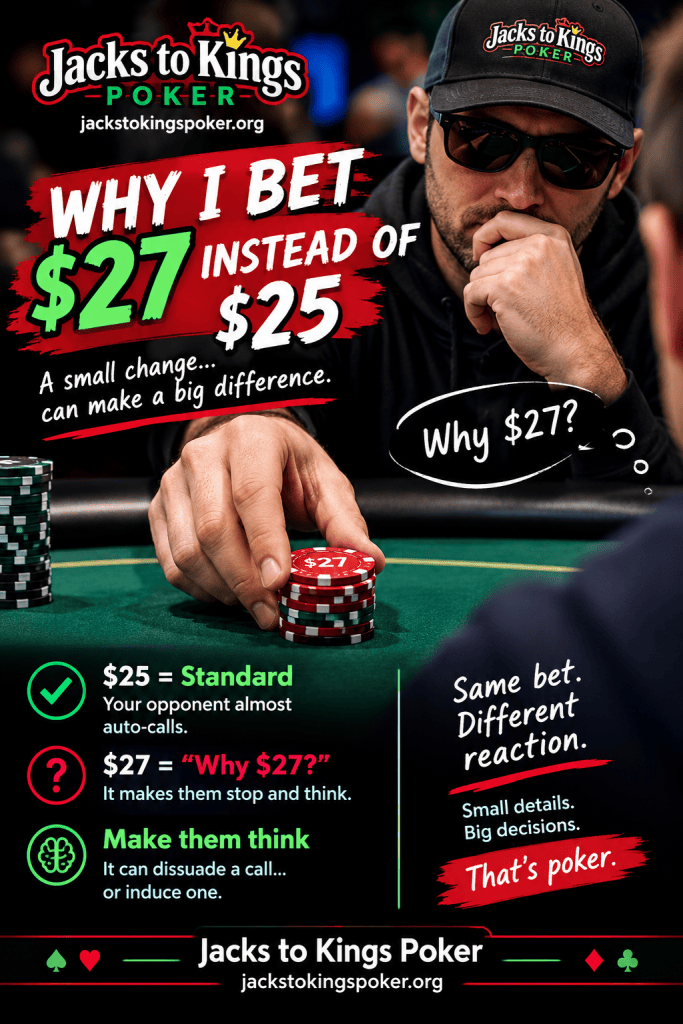
Tonight I was talking to a friend of mine, I call him Lem, As usual we were talking poker strategy and we got into a strategy we both enjoy to mix things up a bit that when used correctly mixes up the game and can even throw good players off balance.
Sometimes two extra dollars can make a bigger difference than you think.
In live poker, players get comfortable with familiar bet sizes. $15, $20, $25, $30, $50 — these numbers become almost automatic. That is exactly why occasionally using an odd-dollar amount can throw an opponent off.
Instead of betting $25, try $27.
Instead of $50, maybe $53.
It isn’t about trying to look clever or turning every bet into a math problem. It’s about breaking your opponent’s rhythm and making them stop for a second to think about what your bet actually means.
Why Does $27 Feel Different Than $25?
Imagine you’re playing $1/$3 No-Limit Hold’em.
You bet $27 on the flop.
Your opponent was probably expecting something like $20, $25, or $30. Now they’re looking at $27 and have to process it.
“Why $27?”
That tiny question can be valuable.
Maybe they interpret it as a very specific value bet. Maybe they think you’re trying to discourage a call. Maybe they believe you’re uncomfortable and are trying to buy the pot cheaply.
The important part is that you’ve created uncertainty.
And uncertainty can lead to mistakes.
Odd Sizing Can Dissuade a Call
Suppose you’ve got a strong but vulnerable hand.
The pot is $62 and you bet $27.
A player holding a marginal hand might have been willing to call $25 without thinking much about it. But $27 makes them reconsider.
It’s only $2 more, but psychologically it can feel like a more deliberate decision.
They may think:
“What does he have? Why $27? Is he trying to set the price of the hand?”
Sometimes that extra hesitation is enough to turn a marginal call into a fold.
That’s especially useful against players who don’t like making difficult decisions.
But It Can Also Induce a Call
Here’s the fun part.
Odd sizing doesn’t always discourage a call. Sometimes it can encourage one.
Imagine you bet $27 with a hand you’re willing to get value from, and your opponent thinks:
“That’s a weird number. He’s probably just trying to look strong.”
They may convince themselves that you’re making an unusual bet because you’re bluffing.
Now you’ve accomplished the opposite of what they expected.
They’re calling.
This is where understanding your opponent matters.
Against a player who tends to overthink unusual bets, $27 might induce curiosity. Against a straightforward player who doesn’t want to deal with weird sizing, it might discourage a marginal call.
Same bet. Different opponent. Different reaction.
The Real Trick Is Knowing When to Use It
You don’t want to start betting $23, $27, $31 and $46 on every street.
Then the odd sizing becomes your normal sizing — and you’ve accomplished nothing.
Instead, use it selectively.
Maybe you’ve been betting $25 all night and suddenly fire $27 when you have a big hand.
Or perhaps you’ve been making standard $20 continuation bets and suddenly bet $23 when you’re bluffing.
Now your opponent has something new to think about.
That’s where odd sizing can become part of your table image.
Don’t Confuse Weird With Random
There’s an important distinction.
Odd sizing should have a purpose.
If you’re betting $27 simply because you think $27 looks cool, you’re not necessarily gaining anything.
But if you’re thinking:
● “I want to make this marginal hand uncomfortable.”
● “I want my opponent to wonder why I chose this size.”
● “I want to make calling slightly less automatic.”
● “I think this opponent will interpret an unusual size as weakness.”
● “I want to get a little more value without making the bet look significantly larger.”
Then the sizing has a reason behind it.
And that’s poker.
The Psychological Edge
Poker isn’t just about cards and pot odds.
It’s also about decision-making under uncertainty.
Players become comfortable when everything looks familiar. Standard bet sizes make decisions easier because opponents immediately understand what they’re facing.
An unusual amount interrupts that process.
$25 feels like a bet.
$27 can feel like a message.
Your opponent may not even consciously realize that the number is affecting them. But if it causes them to take an extra few seconds, reconsider a marginal hand, or assign a different range to you, you’ve already accomplished something.
And remember: you’re only risking an extra $2 compared with the $25 bet.
That’s a pretty inexpensive way to make your opponent think.
The Seat 4 Lesson
At the poker table, we’re always looking for little edges.
Sometimes the edge isn’t a huge bluff or a perfectly timed check-raise.
Sometimes it’s simply betting $27 instead of $25.
The goal isn’t to confuse your opponent just for the sake of confusing them. The goal is to make their decisions a little harder while keeping your own decisions intentional.
So the next time you’re reaching for those chips, ask yourself:
Does this really need to be $25?
Maybe $27 tells the better story.

If you enjoyed this article please like,share,comment, and subscribe! Please click on our sponsor links to keep these articles free!
Thank you for reading and I will see you at the tables!

 THE PLAYER IN SEAT 4..
Recent Comments